
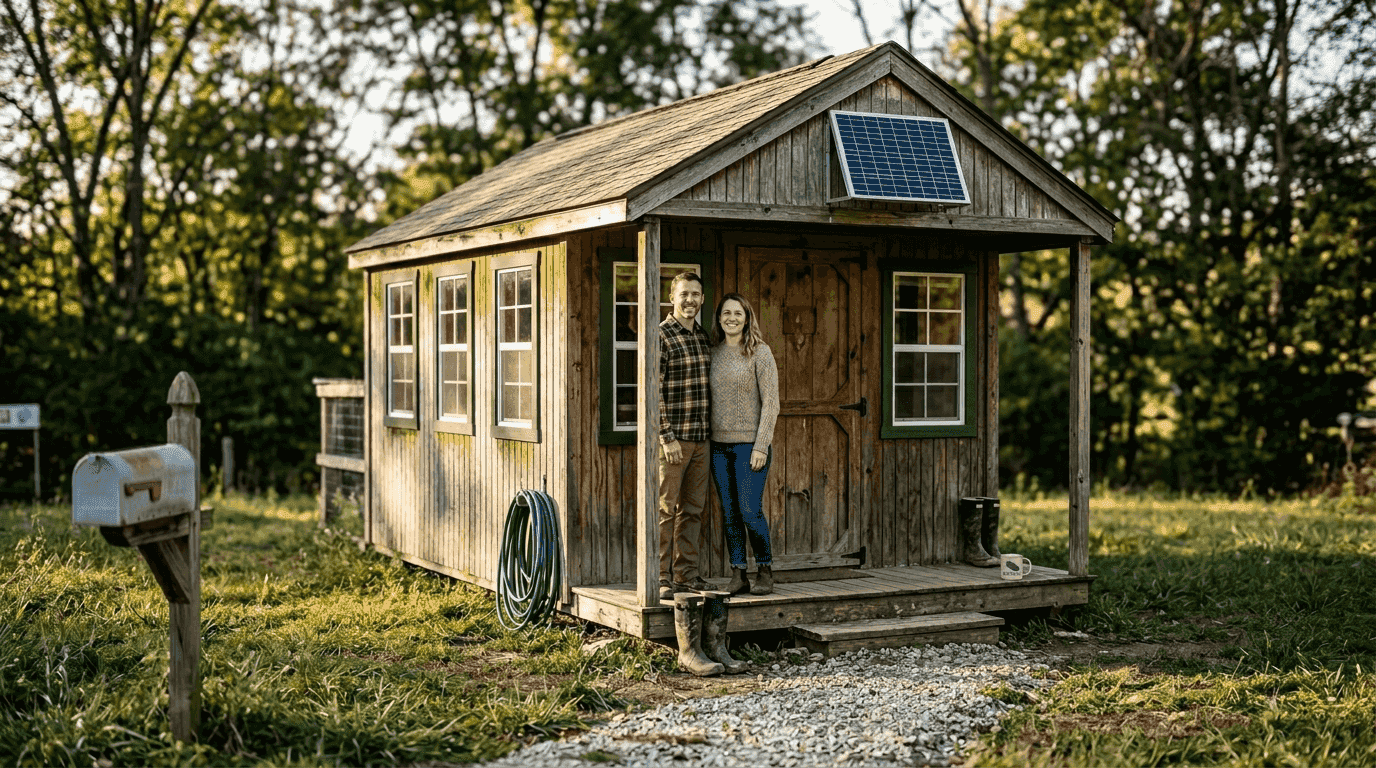
Many homeowners dream of transforming a backyard shed into a cozy living space, but converting a storage shed into a legally habitable tiny home involves far more than adding a bed and calling it done. Shed to tiny home conversion involves transforming a backyard storage shed into a livable space by adding insulation, utilities, flooring, windows, and finishes. In Kentucky and Ohio, zoning laws, building codes, and structural upgrades create unique challenges and opportunities for these projects. This guide breaks down the process, costs, legal requirements, and practical strategies to help you navigate shed conversions successfully in 2026.
Table of Contents
- What is shed to tiny home conversion? Understanding the basics
- Step-by-step process and structural upgrades for shed conversions
- Legal and zoning considerations for shed conversions in Kentucky and Ohio
- Cost breakdown and realistic budgeting for shed-to-tiny-home projects
- Explore affordable sheds and building options with EZ-Cabin
- What permits do I need for a shed conversion in Kentucky and Ohio?
- How much does a typical shed-to-tiny-home conversion cost?
- What are the main challenges in converting a shed into a tiny home?
Key takeaways
| Point | Details |
|---|---|
| Definition | Shed to tiny home conversion transforms storage sheds into functional living spaces with proper utilities, insulation, and structural upgrades. |
| Costs | Projects range from $3,000 for basic shells to $50,000+ for fully finished homes with plumbing and HVAC systems. |
| Legal requirements | Kentucky and Ohio require permits and zoning approval for ADUs, with minimum sizes typically starting at 400 square feet. |
| Structural upgrades | Essential modifications include foundation work, electrical wiring, insulation, proper ventilation, and residential-grade framing. |
| Timeline | Most conversions take 2 to 6 months depending on complexity, permits, and whether you hire contractors or DIY. |
What is shed to tiny home conversion? Understanding the basics
Shed to tiny home conversion means upgrading a basic storage shed into a functional living space suitable for year-round occupancy. Unlike simply moving furniture into an existing shed, true conversion requires substantial modifications to meet building codes and ensure comfort. Shed to tiny home conversion involves transforming a backyard storage shed into a livable space by adding insulation, utilities, flooring, windows, and finishes. These upgrades transform what was once a simple storage structure into a versatile space that can serve as a home office, guest suite, vacation rental, or even a primary residence.
The scope of modifications varies based on your intended use and local regulations. At minimum, you'll need proper insulation to handle Kentucky and Ohio's temperature swings, electrical wiring for lighting and appliances, appropriate flooring that can withstand moisture, and windows that provide natural light and ventilation. More comprehensive conversions add plumbing for kitchens and bathrooms, HVAC systems for climate control, and interior finishes like drywall and trim that create a polished living environment.
Shed sizes and layouts dramatically impact functionality. A 10x16 shed offers 160 square feet, perfect for a man cave shed conversion or home office but tight for full-time living. Larger 12x24 or 14x28 structures provide enough space for loft beds, compact kitchens, and bathroom facilities. Loft designs maximize vertical space, creating separate sleeping areas above main living zones without expanding the footprint.
Structural upgrades form the foundation of any successful conversion. Standard shed framing uses wider stud spacing than residential construction, so reinforcing walls with proper 16-inch on-center framing ensures stability and code compliance. Foundation work prevents settling and moisture intrusion, critical concerns in both states' clay-heavy soils. Proper ventilation systems combat humidity and maintain air quality, especially important when adding cooking and bathing facilities to small spaces.
- Insulation options include spray foam for superior R-value or fiberglass batts for budget-conscious projects
- Electrical systems must meet residential code with proper circuit breakers and grounded outlets
- Window placement affects natural lighting, ventilation, and heating efficiency
- Flooring choices range from vinyl planks to cork or tile depending on moisture exposure
- Loft bed designs create separate sleeping zones in compact footprints
Step-by-step process and structural upgrades for shed conversions
Successful shed conversions follow a methodical approach that addresses structural, mechanical, and finishing requirements in logical sequence. Key methodologies include ensuring drainage and foundation, connecting utilities, installing flooring, insulation, HVAC, and finishing touches. Starting with proper planning and permits prevents costly mistakes and ensures your converted space meets all legal requirements for occupancy.
-
Site preparation and foundation work: Begin by evaluating your existing shed's foundation. Most storage sheds sit on simple skid foundations or concrete blocks inadequate for permanent structures. Upgrade to a proper concrete slab, pier and beam system, or frost-protected shallow foundation that extends below Kentucky and Ohio's frost line (typically 30 to 36 inches). Ensure proper drainage with grading that slopes away from the structure and consider French drains in areas with poor soil drainage.
-
Structural reinforcement: Standard shed framing uses 24-inch on-center studs, but residential code requires 16-inch spacing for load-bearing walls. Add intermediate studs to meet code and provide solid backing for drywall and fixtures. Inspect roof trusses for adequate snow load capacity, particularly important in Ohio's northern counties where winter precipitation accumulates. Reinforce floor joists if the original shed used lighter framing intended only for storage loads.
-
Utility installation: Run electrical service from your main panel or install a subpanel if distance requires. Plan circuits for lighting, outlets, HVAC, and any major appliances like refrigerators or electric heaters. Plumbing requires either connecting to existing home systems or installing a septic system for off-grid setups. Water lines must be insulated and protected from freezing in unheated spaces. HVAC options range from mini-split systems offering both heating and cooling to space heaters paired with window AC units for budget builds.
-
Insulation and weatherproofing: Kentucky and Ohio experience temperature extremes from below zero winters to 90-degree summers, making quality insulation non-negotiable. Spray foam provides the best R-value and air sealing but costs more than fiberglass batts. Target R-19 minimum in walls and R-30 in ceilings for comfortable year-round occupancy. Seal all penetrations around windows, doors, and utility entries with expanding foam or caulk to prevent drafts and moisture intrusion.
-
Interior finishing: Install drywall or tongue-and-groove paneling on walls and ceilings, then add flooring suitable for your climate and use. Vinyl plank flooring offers durability and moisture resistance at reasonable cost. Cork provides natural insulation and comfort underfoot. Ceramic tile works well in bathroom areas. Paint with low-VOC products to maintain healthy indoor air quality in compact spaces.
-
Space-saving features: Maximize functionality with loft beds accessed by ladder or stairs, Murphy beds that fold into walls, and compact kitchen layouts using apartment-sized appliances. Consider combination washer-dryer units, tankless water heaters, and composting toilets if plumbing proves challenging. Built-in storage under stairs, in walls, and beneath lofts keeps clutter minimal in tight quarters.
Pro Tip: Always secure permits before starting construction, even if your county has a reputation for lax enforcement. Unpermitted work creates problems when selling property and can result in orders to remove or demolish non-compliant structures. Budget 10 to 15 percent of your total project cost for permit fees and inspections.
For homeowners considering choosing home office sheds as a first step, many of these same principles apply but with simpler utility requirements since offices typically need only electrical service and climate control.
Legal and zoning considerations for shed conversions in Kentucky and Ohio
Navigating the legal landscape for shed conversions requires understanding that regulations vary dramatically between counties and municipalities in both states. Ohio and Kentucky have varied zoning rules; many require sheds to be converted into permitted ADUs, typically around 400 sq ft minimum for occupancy with foundation requirements. There is no statewide tiny home law in Ohio, meaning each jurisdiction creates its own rules governing accessory dwelling units, minimum dwelling sizes, and permitted uses.
Most zoning codes classify storage sheds as accessory structures not intended for human habitation. Converting a shed into living space requires reclassifying it as an accessory dwelling unit (ADU), guest house, or similar residential structure. This reclassification triggers building code requirements including minimum square footage (often 400 to 950 square feet), permanent foundations, proper egress windows, smoke detectors, and full utility connections. Some jurisdictions prohibit ADUs entirely or restrict them to properties meeting minimum lot size requirements.
Rural areas generally offer more flexibility than urban counties. Franklin County (Columbus) and Cuyahoga County (Cleveland) in Ohio enforce strict ADU regulations with detailed design standards, setback requirements, and owner-occupancy rules. Meanwhile, rural Kentucky counties may have minimal zoning outside incorporated cities, though building permits still apply for structures intended as dwellings. Even in permissive areas, health departments regulate septic systems and well water, adding another approval layer for off-grid conversions.
Permit requirements typically include:
- Building permit application with detailed construction plans and engineering stamps
- Zoning approval confirming the property allows ADUs or accessory residential structures
- Electrical permit for all wiring work, with inspections at rough-in and final stages
- Plumbing permit if adding water supply or waste systems
- Mechanical permit for HVAC installations
- Foundation inspection before pouring concrete or installing permanent supports
- Framing inspection after structural work but before closing walls
- Final occupancy inspection before legal habitation
Failure to follow legal procedures creates serious consequences. Unpermitted conversions may result in fines ranging from hundreds to thousands of dollars, orders to cease occupancy, or even forced demolition of non-compliant structures. Insurance companies often refuse coverage for unpermitted buildings, leaving you financially exposed if fire or storm damage occurs. When selling property, unpermitted structures must be disclosed and can derail transactions or reduce sale prices.
Homeowners should consult local zoning offices early in planning. Request a zoning determination letter confirming your property allows the intended use. Review setback requirements ensuring your shed's location complies with distance rules from property lines, primary dwellings, and easements. Ask about design standards that may dictate exterior materials, roof pitch, or architectural compatibility with your main home. Understanding these requirements upfront prevents expensive redesigns or relocations mid-project.
For those exploring zoning shed conversions in Kentucky and Ohio, working with local contractors familiar with county-specific regulations can streamline the approval process and ensure compliance from day one.
Cost breakdown and realistic budgeting for shed-to-tiny-home projects
Understanding the financial investment required for shed conversions helps homeowners set realistic budgets and avoid mid-project surprises. Costs range broadly from $3k to $5k for basic shells, $8k to $20k for insulated with basic utilities, and $30k to $50k+ for full-featured homes including HVAC and finishes. These figures reflect material and labor costs but exclude the initial shed purchase if you're starting from scratch rather than converting an existing structure.
Three main cost tiers define most conversion projects. Barebones shell conversions focus on making a shed weatherproof and insulated but skip utilities and finished interiors. These $3,000 to $5,000 projects work for storage upgrades or spaces used only in mild weather. Mid-level conversions add electrical service, basic insulation, simple flooring, and minimal finishes, costing $8,000 to $20,000. These spaces function as home offices, workshops, or seasonal guest rooms. Fully finished tiny homes include plumbing, HVAC, quality finishes, and all amenities needed for year-round living, with costs ranging from $30,000 to $60,000 or more depending on size and finish quality.
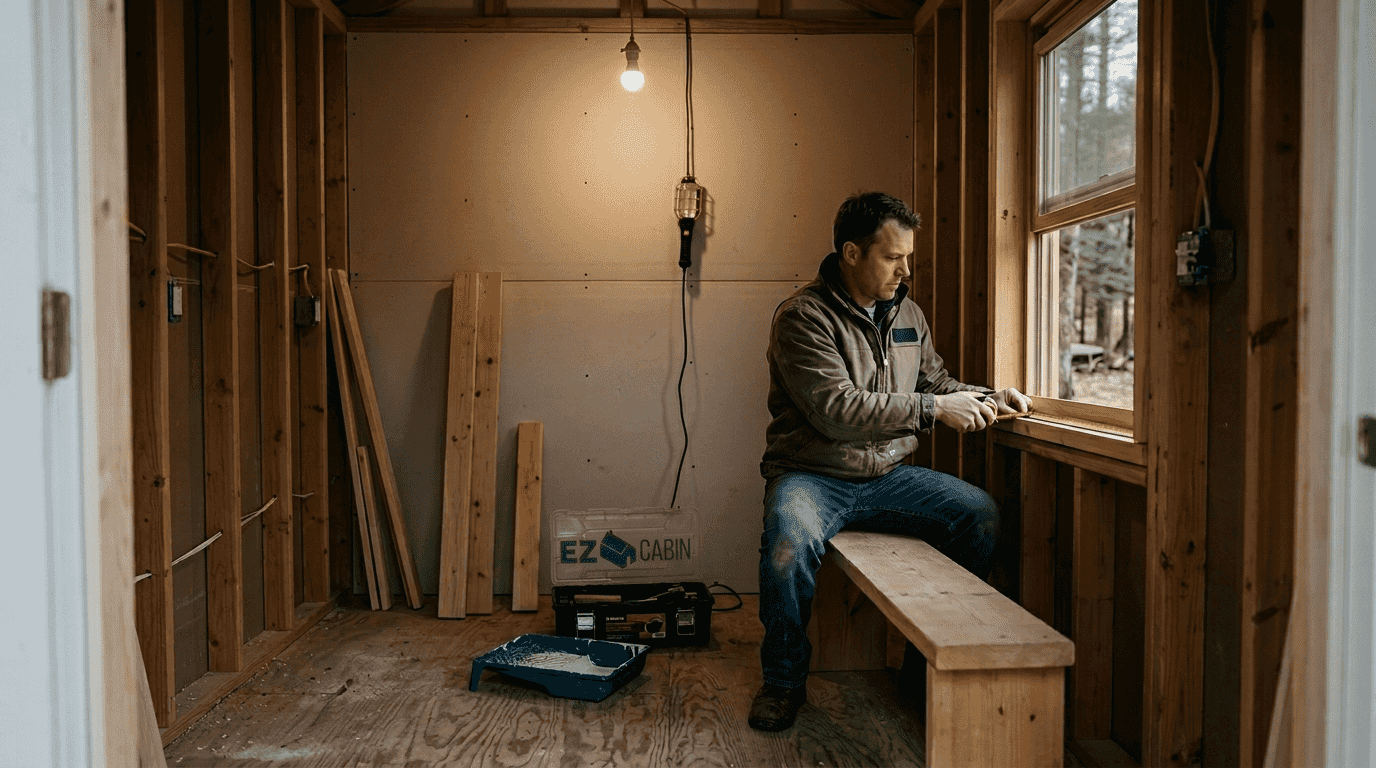
Real-world examples illustrate these ranges. A 10x16 basic getaway cabin with insulation and electrical but no plumbing might cost $8,000 in materials and DIY labor. A $47,000 upgraded Tuff Shed conversion in Kentucky included full utilities, bathroom, kitchenette, and quality finishes in a 12x24 footprint. High-end professional ADU builds can reach $285,000 when including architect fees, premium materials, and full contractor labor, though these projects typically exceed typical shed conversion scope.
Conversion often costs less than building ground-up tiny homes, which average $30,000 to $60,000 for similar square footage. The existing shell provides walls, roof, and basic structure, saving thousands in framing and exterior finish costs. However, retrofitting utilities into existing structures sometimes costs more than roughing them in during new construction, particularly if foundation work requires lifting or moving the shed.
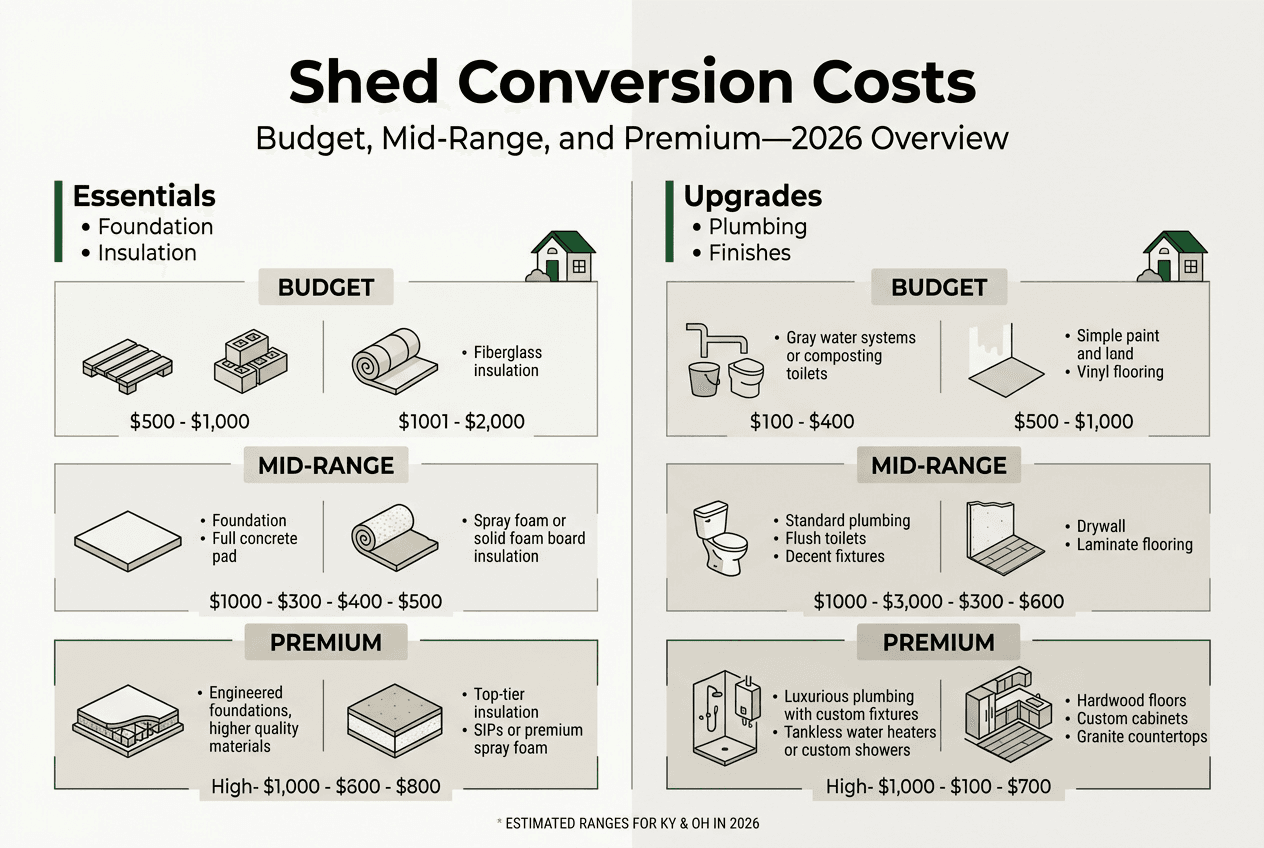
| Cost Category | Budget Option | Mid-Range | Premium |
|---|---|---|---|
| Foundation | Concrete blocks $500 | Pier and beam $2,000 | Full slab $4,000+ |
| Insulation | Fiberglass batts $800 | Closed-cell foam $2,500 | Spray foam + vapor barrier $4,000 |
| Electrical | Basic lights/outlets $1,200 | Full panel + HVAC circuits $3,000 | Smart home integration $5,000+ |
| Plumbing | None | Basic sink/toilet $3,500 | Full bath + kitchen $8,000+ |
| HVAC | Window AC + space heater $600 | Mini-split system $2,500 | Ducted heat pump $6,000+ |
| Finishes | Plywood walls $1,000 | Drywall + vinyl floors $4,000 | Custom cabinets + tile $10,000+ |
Extra costs beyond basic construction include permit fees ($200 to $1,000 depending on jurisdiction), structural engineering if required ($500 to $2,000), unexpected foundation improvements when soil conditions prove poor, and upgraded insulation if energy efficiency matters. HVAC costs vary dramatically based on system type and whether you need both heating and cooling. Finishing touches like custom cabinetry, quality fixtures, and built-in furniture add thousands but dramatically improve livability.
Pro Tip: Salvaging materials from renovation projects, Habitat ReStores, or online marketplaces can cut costs substantially. Reclaimed wood flooring, used windows, and surplus building materials often cost 50 to 75 percent less than new. Phased construction spreads expenses over time, letting you complete the shell and utilities first, then finish interiors as budget allows. This approach also lets you use the space sooner, even if not fully complete.
For insights into small building cost considerations specific to Kentucky and Ohio markets in 2026, regional material costs and contractor rates impact final project expenses significantly. Urban areas typically see higher labor costs than rural regions, though material prices remain relatively consistent statewide.
Explore affordable sheds and building options with EZ-Cabin
Starting your shed to tiny home conversion journey requires finding the right base structure that matches your vision and budget. EZ-Cabin offers a wide variety of sheds, cabins, and portable buildings across Kentucky and Ohio, providing ideal starting points for conversion projects. Our flexible rent-to-own options make beginning your shed conversion affordable without large upfront payments, requiring only the first month's payment to get started with guaranteed financing approval and no credit checks.
Our customizable buildings let you tailor structures to your specific needs before purchase using AI-powered design tools. Adjust layouts, select exterior colors, choose door and window placements, and add functional upgrades in real time to visualize your finished space. Whether you need a compact 10x16 office conversion or a spacious 14x28 structure for full-time living, shop all buildings to explore inventory or use our custom build options to design from scratch. Most buildings deliver within 1 to 4 weeks to locations across Kentucky and Ohio, letting you start your conversion quickly. Protect your investment with integrated security through the Base44 building security app, giving you peace of mind as your project progresses.
What permits do I need for a shed conversion in Kentucky and Ohio?
Shed conversions typically require building permits and zoning approval to reclassify the structure as an accessory dwelling unit or livable space. Most jurisdictions mandate separate permits for electrical, plumbing, and mechanical work, each requiring inspections at rough-in and final stages. Contact your local zoning office early in planning to confirm specific requirements, setback rules, and whether your property allows ADUs. Rural areas may have simpler processes than urban counties, but all conversions intended for habitation need proper permits to ensure safety and legal occupancy.
How much does a typical shed-to-tiny-home conversion cost?
Cost varies dramatically based on finish level and amenities, ranging from $3,000 for basic weatherproofing to $50,000+ for fully finished tiny homes with plumbing and HVAC. Average mid-range projects including insulation, electrical service, basic finishes, and simple kitchenettes typically cost $8,000 to $20,000. These figures exclude the initial shed purchase if starting from scratch. DIY labor reduces costs substantially compared to hiring contractors for all work, though electrical and plumbing often require licensed professionals to pass inspections.
What are the main challenges in converting a shed into a tiny home?
Major challenges include meeting building codes that require residential-grade framing, proper foundations, and full utility connections rather than the simpler construction used for storage sheds. Upgrading structural foundations and reinforcing framing to handle dwelling loads adds complexity and cost. Proper insulation and climate control prove critical in Kentucky and Ohio's temperature extremes, requiring investment in quality materials and HVAC systems. Skipping permits to avoid fees creates serious legal issues including fines, forced demolition, insurance coverage denial, and problems selling property. Working with local contractors familiar with county regulations helps navigate these challenges successfully.