

TL;DR:
- Many small business owners mistake small warehouses for just larger storage units, but they are active workspaces crucial for receiving and shipping inventory. Proper zoning, layout, and size considerations tailored to workflow ensure businesses operate legally and efficiently, unlike passive self-storage units. Evaluating local options and understanding operational needs help determine whether a portable building or leased space best fits your growth plans.
Many small business owners think a small warehouse is just a bigger storage unit. It isn't. A small warehouse is a working space, and understanding what is a small warehouse versus what self-storage actually offers can save you from a costly zoning mistake, a lease that limits your operations, or a building that doesn't fit how your business actually moves. If you're running a product-based business in Kentucky or Ohio and you need space to receive, pack, and ship inventory, this guide will walk you through exactly what you need to know before you sign anything or park a container in your parking lot.
Table of Contents
- Defining a small warehouse: size, zoning, and use
- Comparing small warehouses with self-storage units
- Sizing your small warehouse: what fits your business needs?
- Affordable and portable small warehouse options in Kentucky and Ohio
- Key insights and challenges for small warehouse users
- Why "small warehouse" means different things and what you should really consider
- Explore small warehouse and portable building solutions with EZ-Cabin
- Frequently asked questions
Key Takeaways
| Point | Details |
|---|---|
| Definition varies by size | Small warehouses typically range from 500 to 10,000 square feet, designed for active business use, not just storage. |
| Zoning matters | Small warehouses allow active operations like receiving and packing, unlike self-storage which only permits passive storage. |
| Workflow space is key | Effective warehouse sizing includes space for staging, packing, and work areas beyond inventory storage. |
| Clear height impacts capacity | Ceiling height and racking compatibility determine usable pallet volume more than footprint alone. |
| Flexible local options | Kentucky and Ohio small businesses can choose from portable storage and small warehouse rentals with flexible terms. |
Defining a small warehouse: size, zoning, and use
The definition of small warehouse is broader than most people realize. A flex or light-industrial space often under 5,000 sq ft typically qualifies, combining active business use with storage under one roof. That distinction, "active use," is what separates a warehouse from a storage unit in both a legal and practical sense.
Small bay industrial properties have tenant units ranging from 1,000 to 10,000 sq ft, complete with loading doors and dedicated office space, designed specifically for light manufacturing and distribution. Small warehouse size, in practice, depends on your market and your local zoning code, not just a national standard.
Here is what a legitimate small warehouse typically includes:
- Drive-up roll-up doors for freight and vehicle access
- Concrete floors rated for pallet jacks and forklifts
- Dedicated receiving and shipping areas separate from storage racks
- Office or mezzanine space within the unit for administrative work
- Three-phase electrical service in many light-industrial units
- Clear ceiling heights of 12 to 24 feet, affecting vertical storage capacity
For a deeper look at setting up your space correctly, the small warehouse setup guide covers layout and inventory flow from the ground up.
Comparing small warehouses with self-storage units
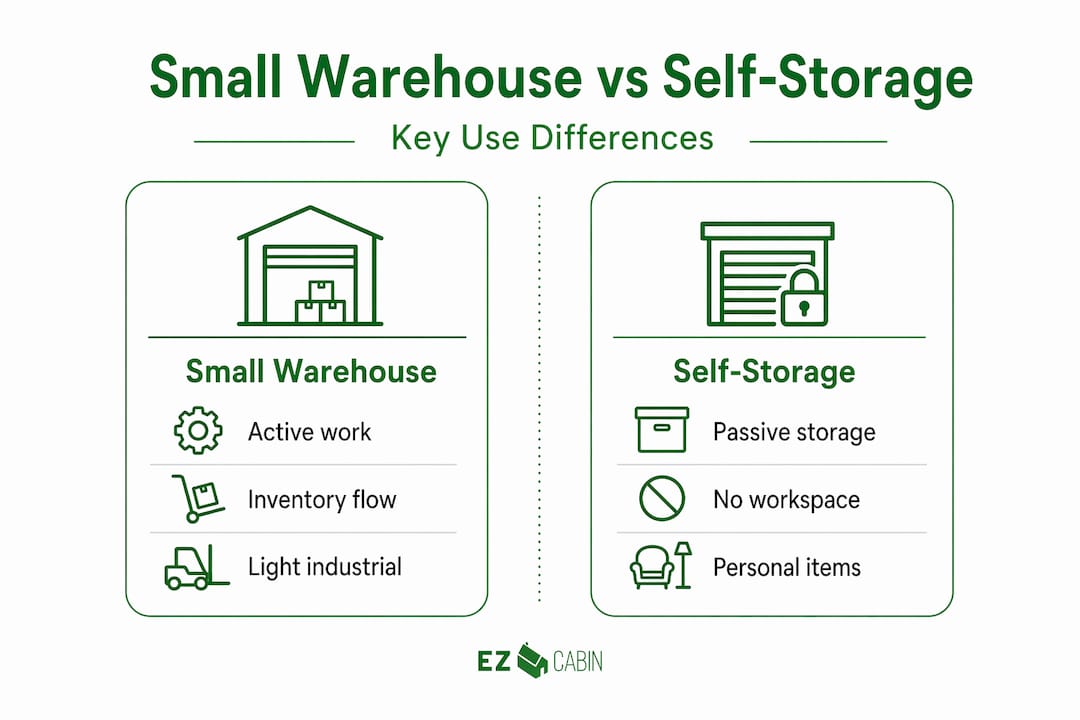
This is where business owners get burned. Self-storage units are zoned for passive storage only, meaning you cannot legally run a business from inside one. No receiving deliveries to resell, no operating equipment, no packing orders. Self-storage allows only passive storage, while micro warehouse space permits active operations including receiving shipments and running equipment on site.
Portable storage containers fall somewhere in between. Portable containers provide secure onsite storage but do not replace the flex or light-industrial space you need for workspace and legal operations. They're useful for inventory overflow during peak season, but they don't solve the problem of needing a place to actually work.
Here's a direct comparison:
| Feature | Small warehouse | Self-storage unit | Portable container |
|---|---|---|---|
| Active operations allowed | Yes | No | Rarely |
| Drive-up loading access | Yes | Limited | Yes |
| Climate control options | Often | Sometimes | Rarely |
| Office or work space | Yes | No | No |
| Legal zoning for business | Light industrial | Storage only | Temporary/onsite |
| Flexible lease terms | Yes | Yes | Yes |
The key takeaway: if your business involves receiving, processing, or shipping goods, only a small warehouse gives you the legal and physical infrastructure to do that. For context on how commercial construction affects zoning and building codes, that distinction matters before you commit to any space.
Pro Tip: Before leasing any space, ask the landlord or municipality directly whether the zoning classification allows "light industrial" or "flex industrial" use. Storage-only zones can shut down your operations without warning.
If you're still weighing your building options, types of portable buildings breaks down what each structure is actually designed for.
Sizing your small warehouse: what fits your business needs?
Most people start with square footage and work backward. That's the wrong approach. Start with your workflow, then calculate the space you need to run it without bottlenecks.
A small warehouse is generally under 5,000 sq ft, with most small businesses working well in 500 to 2,500 sq ft depending on workflow needs. But here's the part most articles skip: usable capacity depends on ceiling height and pallet racking compatibility, not just square footage. A 2,000 sq ft unit with a 12-foot clear height stores far fewer pallets than the same footprint with an 18-foot clear height.

Use this table as a starting reference for matching business size to warehouse needs:
| Business type | Recommended size | Key considerations |
|---|---|---|
| Freelance e-commerce | 200 to 500 sq ft | Shelving, parcel access |
| Small product retailer | 500 to 1,500 sq ft | Receiving dock, staging area |
| Wholesale distributor | 1,500 to 5,000 sq ft | Pallet racking, forklift aisle |
| Light manufacturer | 2,500 to 10,000 sq ft | Equipment space, three-phase power |
Follow these steps to size your space accurately:
- Calculate your inventory footprint. Measure current pallet or shelf count and multiply by 20 sq ft per pallet position, accounting for aisle clearance on both sides.
- Add workflow space. Inbound staging, packing stations, and outbound staging each need 10 to 15 percent of total floor space beyond your storage racks.
- Factor in ceiling height. If your unit has a 16-foot clear height, you may be able to cut your footprint by 30 percent through vertical racking.
- Plan for growth. Add 20 to 25 percent to your calculated need if you expect inventory to grow in the next 18 months.
- Include office or admin areas. Even a 100 sq ft partitioned corner for a desk and computer changes how efficiently you run daily tasks.
Pro Tip: When touring a warehouse, bring a tape measure and check the "clear height," the distance from finished floor to the lowest overhead obstruction like a beam or sprinkler head. This number determines how many pallet levels you can actually stack.
The small warehouse setup guide goes deeper on layout planning for KY and OH businesses specifically.
Affordable and portable small warehouse options in Kentucky and Ohio
Kentucky and Ohio have a healthy mix of portable and fixed warehouse options designed for small business owners who need flexibility without long-term commercial lease commitments.
Kentucky and Ohio providers offer portable storage trailers alongside small warehouse rentals from 1,000 to 25,000 sq ft, with flexible terms tailored for small businesses. That range matters because you can start small and scale up without relocating your entire operation.
On the portable side, Xtra Storage operates over 500 portable trailers serving KY and OH, with over 200,000 sq ft of onsite warehousing delivered to customer locations. For businesses dealing with seasonal inventory spikes, that kind of flexible deployment is far cheaper than locking into a fixed lease.
Here's what to look for when evaluating local options:
- Flexible lease terms of 3 to 12 months rather than multi-year commitments
- Variable unit sizes so you can scale up or down as inventory shifts
- Drive-up access with adequate turning radius for delivery trucks
- Security features including surveillance and keyed or coded entry
- Climate control availability for temperature-sensitive products
Steps for evaluating a small warehouse rental in KY or OH:
- Confirm the zoning classification allows your specific business operations.
- Verify ceiling height and available racking infrastructure.
- Ask about utility costs, especially electricity for climate control.
- Review move-in and move-out flexibility in the lease terms.
- Check local delivery access, meaning whether your freight carriers can reach the location reliably.
For more context on building your own space, the Ohio portable building guide covers permits, investment considerations, and customization options. And for a broader look at building types, affordable portable buildings outlines what is available across the region.
Key insights and challenges for small warehouse users
Running a small warehouse sounds straightforward until you're in one. Here are the problems business owners encounter that nobody warns them about.
Zoning surprises kill operations. Active business use requires proper zoning, physical layouts that support workflows, and awareness of warehouse clear height for usable capacity. Always verify zoning before signing a lease, not after.
Square footage lies. Two spaces with the same footprint can differ radically in pallet capacity because of ceiling height and racking compatibility. A warehouse that looks right on paper can be completely wrong for your needs once you're inside.
Here's a summary of the most common pitfalls:
- Ignoring workflow zones. Storage is only one function. Inbound staging, order picking, packing, and outbound staging each take floor space, and skipping them in your planning creates bottlenecks fast.
- Underestimating growth. Businesses that lease "just enough" space often need to move within 12 months, which means double the disruption and moving costs.
- Using portable containers as a permanent solution. Containers work well for overflow, but they don't replace a working warehouse because they lack climate control, workspace, and legal standing for ongoing business operations.
- Missing utility costs in the budget. Electricity, especially for climate control, can add hundreds of dollars per month to your cost of small warehouse rental. Always ask for historical utility bills before signing.
"The biggest mistake small warehouse tenants make is treating the decision like a self-storage rental. It's not. The zoning, layout, and infrastructure all affect what you can legally and practically do inside the space."
Pro Tip: When budgeting for a small warehouse, add 15 to 20 percent to the base rent figure to cover utilities, insurance, security, and basic racking setup. That gives you a realistic total cost from day one.
The small warehouse setup guide is a practical reference for avoiding these setup mistakes in your first few months.
Why "small warehouse" means different things and what you should really consider
The term "small warehouse" spans a wide range, from 500 sq ft to under 100,000 sq ft depending on the source, the industry, and the local market. That inconsistency isn't a flaw in the definition. It's a signal that you should stop looking for a category and start looking at your own operation.
Here's the honest truth about how most small business owners approach this decision: they search for a size category, find a building that fits it, and then try to make their workflow fit the building. That's backward. The businesses that get this right start with their operational reality. How many pallets do they move per week? Do they receive freight daily or once a month? Do they need a desk inside or just floor space? The answers to those questions define what "small warehouse" actually means for them.
Portable and micro warehouse solutions have blurred the traditional lines between storage and active workspace. A well-configured portable building can function as a legitimate small warehouse for an e-commerce business that ships 50 orders a day. A converted container with no climate control cannot. The building type matters less than whether the space supports your specific workflow.
Local market conditions in Kentucky and Ohio also affect your options in ways that national benchmarks don't capture. Rural areas outside Louisville or Columbus have very different availability, pricing, and zoning flexibility than urban submarkets. What's a reasonable cost of small warehouse space in Lexington may be completely different in a smaller county seat. Small warehouse management in a smaller market also means fewer service providers and more reliance on self-managed systems.
The question "is a small warehouse viable for my business?" has an answer specific to you, not to a category. Start with your workflow. Then find the space that fits it, whether that's a leased bay, a delivered portable building, or a combination of both.
For practical next steps, the small warehouse setup guide gives you a workflow-first planning framework designed for KY and OH businesses.
Explore small warehouse and portable building solutions with EZ-Cabin
If you've worked through this guide and realize your business needs dedicated, flexible space that you actually own or rent-to-own rather than lease from a landlord, EZ-Cabin builds exactly that.
EZ-Cabin offers customizable portable buildings that work as small warehouses, storage combinations, and office-workspace hybrids, delivered to your site in Kentucky or Ohio within 1 to 4 weeks. You can build your own portable building using their AI-powered configurator to dial in the layout, doors, windows, and dimensions before you buy. Need to protect your inventory? Secure your building with Base44 APP to add smart security monitoring from day one. Financing is straightforward too: EZ-Cabin offers guaranteed financing approval with no credit check required and only the first month's payment needed to get started.
Frequently asked questions
What size qualifies as a small warehouse?
A small warehouse size typically ranges from 500 to 10,000 sq ft, with most small businesses operating comfortably in 500 to 2,500 sq ft depending on workflow and inventory volume.
Can I run active business operations in a small warehouse?
Yes. Small warehouses are zoned for light industrial use, allowing active operations like receiving deliveries, running equipment, and packing orders, unlike self-storage units that only permit passive storage.
Are portable storage containers the same as small warehouses?
No. Portable containers provide secure storage but lack workspace, climate control, and the legal zoning required for ongoing active business operations that a small warehouse provides.
How do I choose the right small warehouse size for my business?
Start with workflow space beyond your inventory footprint, then factor in ceiling height for pallet racking capacity, and build in at least 20 to 25 percent extra for future growth.
What small warehouse options are available in Kentucky and Ohio?
Local KY and OH providers offer both portable storage containers and small warehouse rentals ranging from roughly 1,000 to 25,000 sq ft, with flexible lease terms suited to small businesses at various growth stages.