
TL;DR:
- AI enhances portable building design by reducing planning time and minimizing errors through generative and parametric modeling. It allows real-time customization, accelerates production, and lowers costs by optimizing layouts and material use. However, effective implementation depends on high-quality data, interoperability, and human judgment for final decisions.
Most people assume AI in building design means robots replacing architects. That's not what's happening. The real role of AI in portable building customization is far more practical and immediately useful. It means faster design cycles, fewer costly errors, and the ability to personalize a cabin, office, or shed to your exact specifications before a single board is cut. If you've been shopping for a portable structure and wondering how technology is changing what's possible, this guide breaks down exactly what AI does, what it doesn't do, and how you can use it to your advantage.
Table of Contents
- Key takeaways
- The role of AI in portable building customization
- Concrete benefits you actually notice
- Challenges worth knowing before you commit
- How to use AI customization to your advantage
- My take on AI and portable buildings after years in this space
- Design your perfect portable building with Ez-cabin
- FAQ
Key takeaways
| Point | Details |
|---|---|
| AI accelerates design cycles | Generative tools reduce the geometry solution phase in architecture by 60–70%, getting you to a finished design faster. |
| Real-time personalization is now standard | AI configurators let buyers adjust layouts, colors, and features instantly, with changes propagating in about 9 minutes. |
| Human expertise still drives decisions | AI handles data-heavy tasks but relies on human judgment for final design calls and structural interpretation. |
| Interoperability matters when choosing a provider | Providers using open standards like IFC protect your design assets and avoid vendor lock-in. |
| AI lowers cost through precision | Optimized layouts reduce material waste, making AI-powered custom buildings more affordable than traditionally designed ones. |
The role of AI in portable building customization
When people talk about AI in building design, they often picture something futuristic. The reality is already here and it's more practical than flashy. AI in portable building customization relies on three core technologies: generative design, parametric modeling, and machine learning.
Generative design is software that generates multiple layout and structural options based on constraints you set, like square footage, window placement, or door count. You define the rules; the AI explores every possible configuration that fits them. For portable cabins or modular offices, this means getting dozens of viable layouts in minutes rather than days.
Parametric modeling works differently. It creates a design where every element is linked by relationships. Change the roof pitch, and the wall height adjusts automatically. Change the footprint, and the window placements recalculate. This matters enormously for portable buildings because modular structures often need to fit very specific site conditions, zoning setbacks, or personal preferences.
Machine learning pulls from previous projects. If a manufacturer has built 500 cabins, the AI can analyze which configurations led to faster builds, fewer material overruns, and higher customer satisfaction. That data shapes the options offered for new projects.
- Generative design generates multiple layout configurations from user-defined constraints
- Parametric architecture links all building elements so one change updates everything
- Machine learning informs new designs using patterns from past completed projects
- AI-driven simulation models energy use, structural loads, and spatial flow before production
Pro Tip: When evaluating AI-powered portable building platforms, ask whether the configurator uses parametric modeling or just a static image tool. Parametric tools actually change the design; static tools only change how it looks on screen.
AI also plays a role in modular building optimization by running simulations that test structural integrity and energy efficiency before any physical component is built. That's the part most buyers never see but absolutely benefit from.
Concrete benefits you actually notice
The efficiency gains from AI aren't abstract. They show up in your timeline, your budget, and how closely the finished structure matches what you actually wanted.
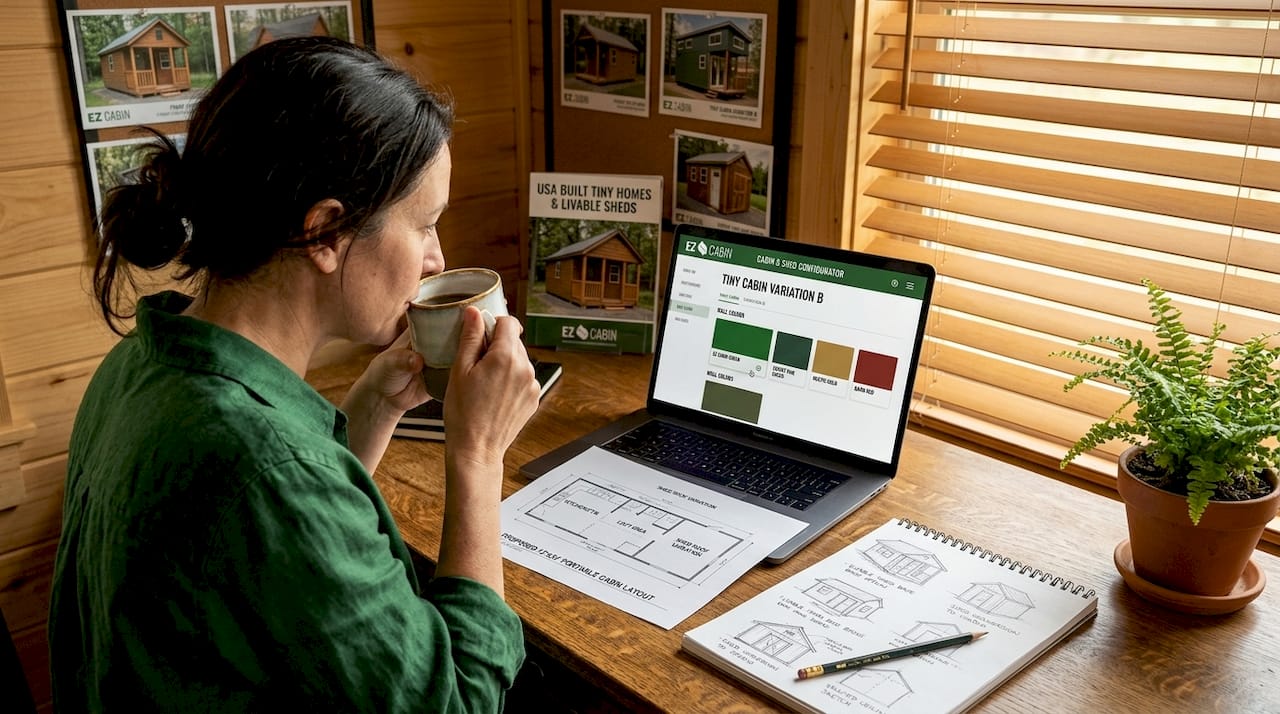
Generative design tools shorten the geometry solution phase in architecture by 60 to 70%. For a portable cabin buyer, that means the design phase that once took weeks can now wrap up in days. You spend less time waiting and more time moving toward delivery.
Speed improvements extend into production as well. AI-driven manufacturing systems enable prefab home manufacturers to build structures 2.5 times faster than traditional methods, compressing timelines from the typical 6 to 18 months down to 4 to 5 months. That's not a marginal improvement. That's a fundamentally different experience for the buyer.
Perhaps the most underappreciated benefit is how quickly design changes propagate. When you decide to move a window or add a loft, that engineering change update completes across all production documents in about 9 minutes. No manual rework. No waiting for a designer to redraw the spec sheet.
The precision gains also reduce waste. When AI calculates exactly how much lumber, roofing material, and insulation a specific layout requires, manufacturers order and cut to spec. Less waste means lower material costs, and those savings can be passed along.
Here's a summary of the most measurable benefits:
- Design phase time cut by 60 to 70% through generative tools
- Build timelines reduced from months to weeks with AI-driven manufacturing
- Material waste reduced through layout optimization
- Design changes reflected across all documents in under 10 minutes
- Higher accuracy in production specs, reducing costly rework
Challenges worth knowing before you commit
AI does a lot of things well. But buyers and builders who go in with unrealistic expectations tend to get frustrated when reality doesn't match the hype.
The biggest limitation is data quality. AI systems are only as good as the inputs they receive. Unstructured or inconsistent data, like rough sketches, verbal descriptions, or incomplete site measurements, produce unreliable outputs. Main barriers to AI adoption in construction include data inconsistency, legal uncertainties, and safety compliance gaps. If a provider's configurator doesn't have clean, structured inputs built into its interface, the AI layer on top won't save it.
Interoperability is another real concern. Not every AI design tool plays nicely with every manufacturer's production software. If the design file your AI configurator produces can't be read by the factory's cutting machines or BIM software, someone has to manually translate it. That translation step reintroduces the errors AI was supposed to eliminate.
The good news is that open standards like IFC and BCF address this problem. Vendor-neutral standards like IFC keep AI-generated designs interoperable across platforms, protecting your design data and your investment.
Then there's the human judgment factor. AI can flag a clash between a structural beam and a proposed window placement. What it can't do is weigh that against your personal priorities, your site's unique characteristics, or local code requirements. The most effective AI implementations handle data-heavy tasks to free up human creativity and decision-making, not to replace it.
Pro Tip: Before choosing a portable building provider, ask whether their design files can be exported in open formats like IFC, DXF, or JSON. If the answer is no, your design data may be locked to their platform.
How to use AI customization to your advantage
Knowing AI exists isn't enough. Here's how to actually use it when you're in the market for a portable building.
-
Start with a parametric configurator, not a static gallery. Browsing photos of finished buildings tells you what's possible. A parametric configurator lets you build what you actually want. Look for platforms where changing one element visibly updates others in real time.
-
Define your constraints upfront. AI tools perform best when given clear parameters. Know your footprint limits, your must-have features, your budget ceiling, and any site restrictions like setbacks or height limits. Feed those in first.
-
Ask about the feedback loop timeline. One of the clearest signs of a well-integrated AI system is how quickly design changes show up in updated production specs. If a provider needs days to process a change you made online, they're not running a true AI-connected workflow.
-
Verify open data standards. As noted in the challenges section, your design file should be exportable and readable by standard industry tools. This protects you if you ever want to switch providers, add on to the structure, or work with a local contractor.
-
Work with the human layer, not around it. Even the best AI-driven platform benefits from a human review. Use the AI to explore options quickly, then bring in a knowledgeable sales or design rep to pressure-test your final configuration.
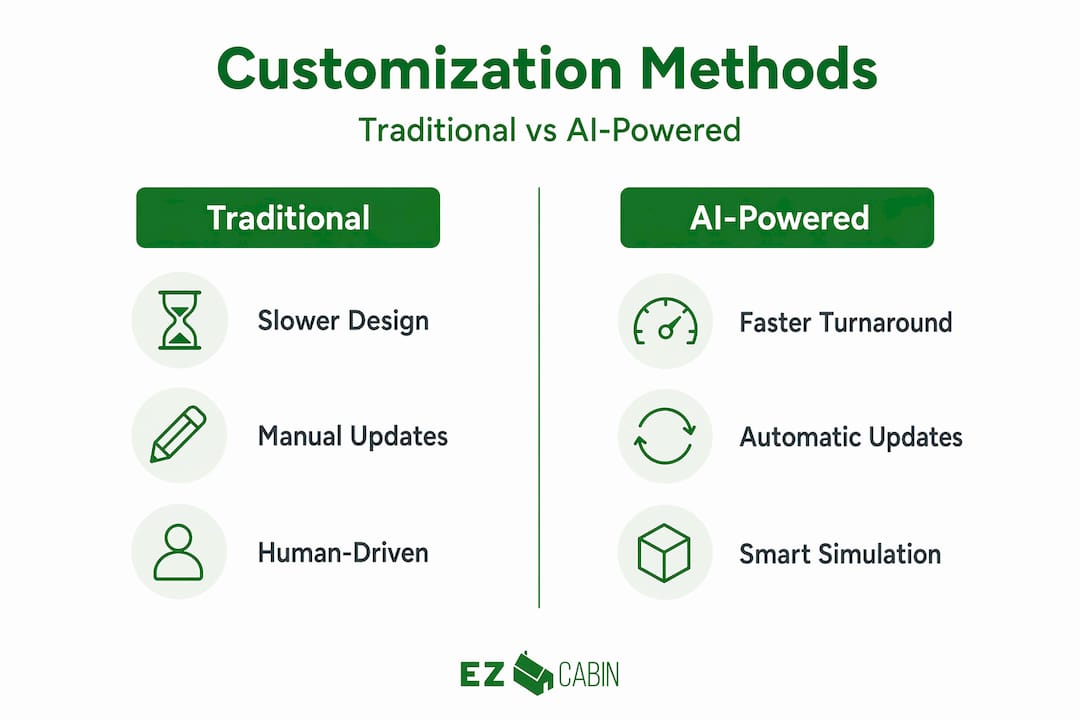
Here's a quick comparison of what AI-powered versus traditional customization looks like in practice:
| Factor | Traditional customization | AI-powered customization |
|---|---|---|
| Design turnaround | Days to weeks | Hours to days |
| Change processing | Manual redraw required | Updates in minutes |
| Material accuracy | Estimated by experience | Calculated from exact specs |
| Personalization depth | Limited by drafting time | Near-unlimited configurations |
| Error detection | Post-production discovery | Pre-production clash detection |
Also worth considering: prefab construction methods already set the stage for AI integration by standardizing components, which gives AI tools clean, structured data to work with from the start.
My take on AI and portable buildings after years in this space
I've watched this industry shift from hand-drawn plans and phone-tag with salespeople to real-time configurators that spit out production-ready specs. And I'll tell you honestly: the technology is impressive, but the biggest mistake I see buyers make is treating the AI tool as the decision-maker.
AI is genuinely good at generating options, catching clashes early, and cutting timelines. What I've learned is that AI as a learning intelligence layer works best when it's embedded throughout the process and not bolted on as a gimmick. The providers who use it well have restructured their entire workflow around it. The ones who use it badly have a flashy frontend sitting on top of the same slow backend they always had.
My advice: ask hard questions before you assume you're getting genuine AI-powered customization. And don't let the speed of a configurator substitute for thinking carefully about what you actually need. The tool can generate 200 layout options in seconds. Only you know which one fits your life.
— Team
Design your perfect portable building with Ez-cabin
Ez-cabin uses AI-powered tools to let you personalize every detail of your portable cabin, office, shed, or studio before you buy. Adjust layouts, exterior colors, window placement, and functional upgrades in real time and see exactly what you're getting.
Start with the Ez-cabin BuildYourOwn configurator to explore layouts and features built around your specific needs. If you want guided configuration with a more structured process, the Ez-cabin Configure tool walks you through every decision step by step. And when you're ready to move forward, Ez-cabin offers rent-to-own financing with no credit check required. Just the first month's payment gets you started, and most buildings deliver within 1 to 4 weeks.
FAQ
What is AI-powered portable building customization?
AI-powered portable building customization uses tools like generative design and parametric modeling to let buyers personalize layouts, features, and specs in real time. Changes are processed automatically across all production documents, often in under 10 minutes.
How much faster is AI-powered design compared to traditional methods?
Generative design tools shorten the design phase by 60 to 70%, and AI-driven manufacturing systems can reduce total build timelines by more than half compared to traditional construction.
Does AI replace the need for a human designer or sales rep?
No. AI handles data-heavy tasks like layout generation and clash detection, but human expertise is still required for interpreting outputs, applying local code requirements, and making final design decisions.
What should I look for in an AI-powered portable building configurator?
Look for real-time parametric updates, open data format exports like IFC or DXF, and a clear link between the design tool and the production workflow. If changes don't update production specs automatically, the AI layer may be superficial.
Can AI help reduce the cost of a custom portable building?
Yes. AI-optimized layouts calculate exact material requirements, reducing waste and over-ordering. Combined with faster design and production timelines, buyers often see lower total costs compared to traditionally designed structures.