
TL;DR:
- Proper legal permits, zoning, and safety standards are essential before warehouse setup.
- Efficient layout and inventory organization significantly reduce operational time and errors.
- Regular audits, clear labeling, and performance metrics help optimize ongoing warehouse performance.
Running a small warehouse sounds straightforward until you're knee-deep in misplaced orders, failed inspections, and aisles so cluttered your team moves at half speed. For small business owners in Kentucky and Ohio, a poorly organized storage space doesn't just slow you down — it chips away at your profit margin with every wrong pick, every delayed shipment, and every scramble during peak season. This guide walks you through every critical step, from legal compliance and layout design to inventory systems and real performance benchmarks, so you can build a warehouse operation that actually works from day one.
Table of Contents
- Assessing your warehouse needs and legal basics
- Optimizing warehouse layout for efficiency
- Organizing inventory for accuracy and speed
- Must-have processes and benchmarks for success
- Troubleshooting, seasonal flexibility, and edge cases
- Our take: What actually works in small warehouse setups
- Next steps: Portable buildings and smart storage solutions
- Frequently asked questions
Key Takeaways
| Point | Details |
|---|---|
| Legal basics first | Always check local zoning and obtain permits before building or leasing a warehouse space. |
| Layout matters | Strategically zone your warehouse with clear labeling and place top sellers nearest outbound. |
| Cycle counts beat annuals | Perform regular inventory cycle counts to boost accuracy and prevent big yearly surprises. |
| Scale your tools | Start with manual tracking for simple setups but shift to barcode or WMS as products and staff increase. |
| Plan for the unexpected | Be ready to adapt for seasonal spikes, team growth, and special inventory needs with flexible storage options. |
Assessing your warehouse needs and legal basics
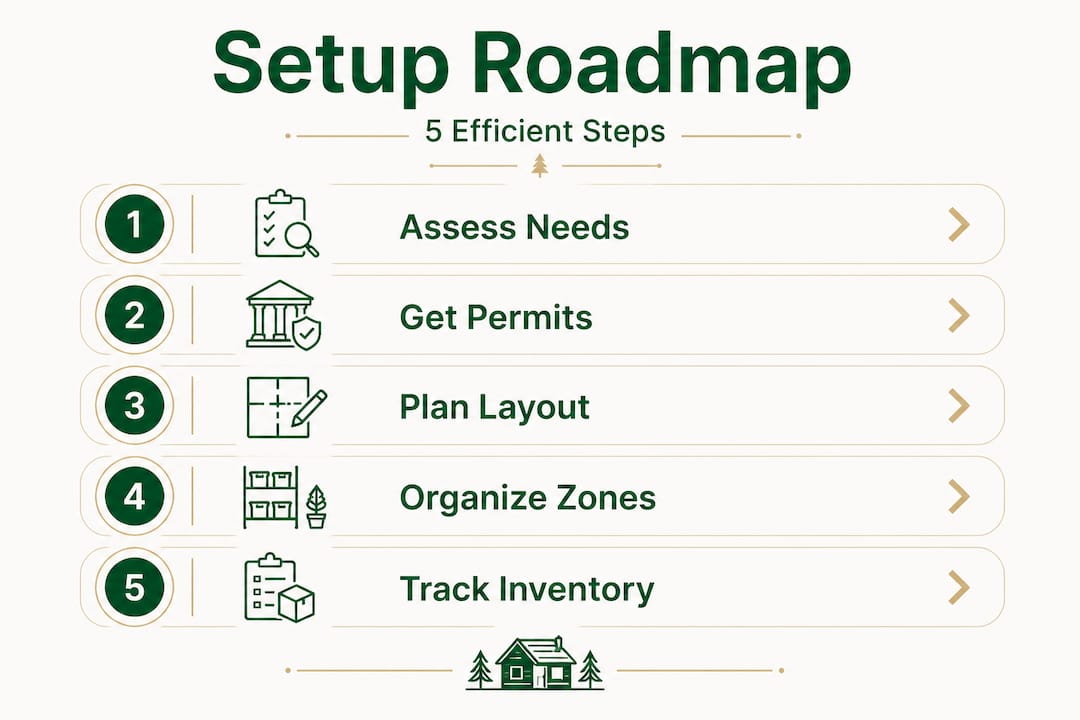
Before you move a single shelf or sign a lease, you need a clear picture of what your warehouse must actually do. Start by listing your SKUs (stock keeping units, which are unique product identifiers), your average and peak inventory levels, and your daily receiving, picking, and shipping volume. A business handling 150 SKUs with 50 outbound orders per day needs a very different setup than one managing 800 SKUs with seasonal spikes.
Define your storage requirements in concrete terms. How much floor space do you need? Do you require dock-level access for freight trucks, or will a standard roll-up door work? Will you store refrigerated goods, hazardous materials, or oversized items? Answering these questions before you commit to a space saves you from costly retrofits later.
Legal requirements are non-negotiable, and they vary by location. Here is a simplified overview of what Kentucky and Ohio small warehouse operators need to address:
| Requirement | Kentucky | Ohio |
|---|---|---|
| Zoning approval | Required for warehouse use | Required for warehouse use |
| Building permit | Required for new construction | Required for new construction |
| Fire permit | Required (especially racking over 8 ft) | Required (especially racking over 8 ft) |
| OSHA compliance | Federal OSHA applies | Federal OSHA applies |
| Vendor's license | Required if selling from premises | Required if selling from premises |
| Racking regulations | Follow NFPA 13 and local codes | Follow federal/NFPA, no state-specific rules |
Per pallet rack permitting rules, for both Kentucky and Ohio you must check local zoning for warehouse use, obtain building and fire permits for racking over 8 feet, and comply with OSHA and NFPA standards. Ohio has no state-specific racking regulations, so you default to federal and NFPA guidance throughout.
Critical warning: Permit processing can take 2 to 6 weeks in most Kentucky and Ohio counties. Apply early. Do not schedule construction, racking installation, or lease start dates before your permits are in hand.
Essential legal steps before you open:
- Confirm your zoning classification allows warehouse or storage operations
- Apply for building permits if constructing or modifying a structure
- Obtain fire permits if installing shelving or racking above 8 feet
- Secure a vendor's license through your state revenue department if you plan to sell from the location
- Review shed installation regulations if you are adding a portable building to an existing property
- Explore portable building options that already meet standard compliance requirements
Getting the legal groundwork right protects you from fines, forced closures, and insurance headaches down the road.
Optimizing warehouse layout for efficiency
With requirements and permits defined, you can safely focus on the physical design of your warehouse. Layout is where most small operations either win or lose significant time every single day.
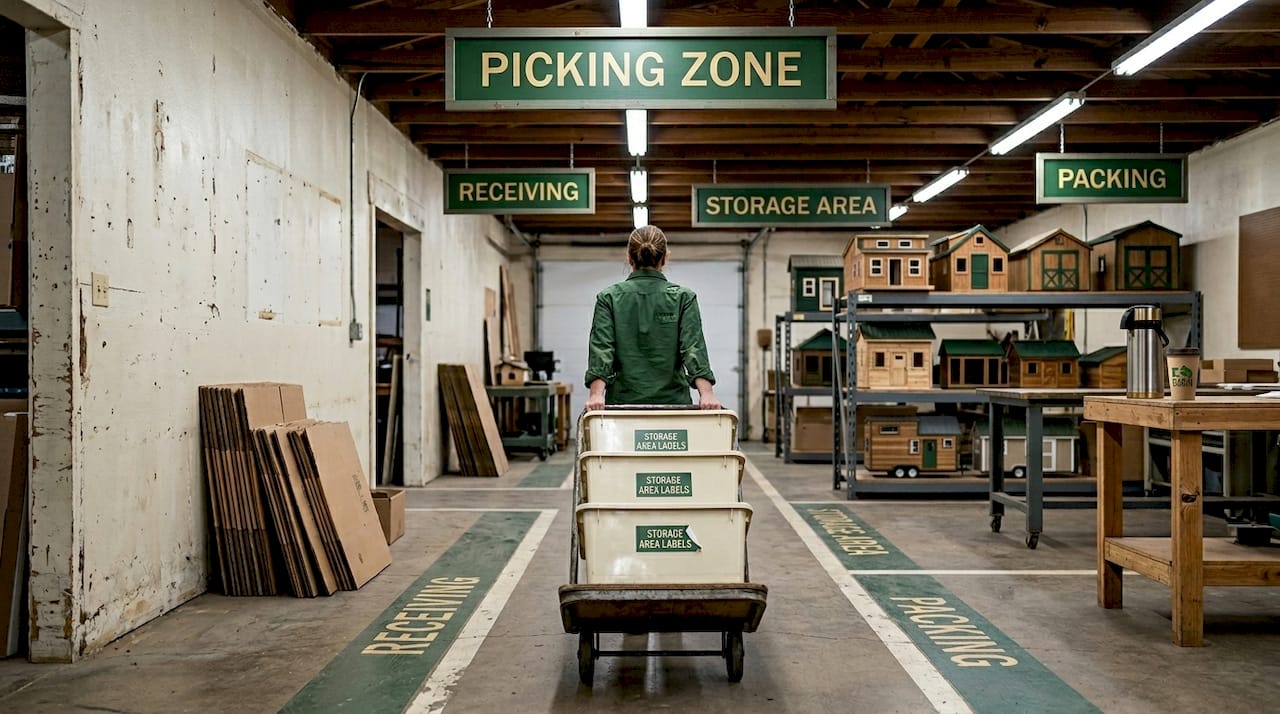
The most effective layouts for small warehouses follow a U-shaped or zone-based flow. In a U-shaped design, goods enter at one end, travel through storage in the middle, and exit through packing and shipping at the other end. This eliminates the cross-traffic that slows down operations in smaller spaces.
Warehouse workflow efficiency depends on creating distinct zones for receiving, storage, picking, packing, and dispatch. Each zone should be clearly marked and sized appropriately for the volume it handles. Receiving zones need enough room to stage incoming pallets and inspect goods before they move into storage. Packing zones need flat, well-lit surfaces with easy access to packing materials.
Comparison of common small warehouse layouts:
| Layout type | Best for | Key advantage | Key limitation |
|---|---|---|---|
| U-shaped | Most small operations | Smooth goods flow | Requires open center space |
| I-shaped | Linear spaces | Simple receiving to ship | Can cause traffic conflicts |
| L-shaped | Corner buildings | Flexible zone placement | Harder to expand |
| Zone-based overlay | Any layout | Versatile and adaptable | Requires clear labeling |
ABC analysis is a practical slotting method where your fastest-moving products (A items) are stored closest to the packing and shipping area. Medium-movers (B items) sit in the middle zone, and slow-movers (C items) go in the back or on higher shelves. This alone can cut your average pick time by a meaningful amount because your team spends less time walking.
Pro Tip: Use vertical storage aggressively. Most small warehouses use only the bottom 6 feet of wall height, leaving 4 to 8 feet of usable space empty above. Install tall racking and use a safety-compliant rolling ladder. You can often double your storage capacity without adding a single square foot of floor space. Pair this with space optimization tips to get even more out of your current footprint.
Aisle markers are underrated. Paint floor lines, hang ceiling signs, or use industrial tape to mark travel paths. This speeds up new team members, reduces picking errors, and keeps safety inspections clean.
Organizing inventory for accuracy and speed
A well-planned layout deserves an inventory system that keeps you accurate and efficient. Physical space means nothing if your team cannot find what they need in seconds.
Step-by-step inventory organization:
- Assign fixed locations to every SKU. Do not let team members "find a good spot" for new inventory. Assign bin codes like A1, B3, or C12 to every shelf position before products arrive.
- Label everything clearly. Shelves, bins, floor zones, and aisles all need readable labels at eye level and at the floor level for forklift operators. Clear labeling with fixed location codes and ABC groupings near packing areas is one of the highest-return investments in warehouse organization.
- Group similar items together. Keep related SKUs in adjacent bins so pickers can grab multiple items from one zone without backtracking.
- Apply ABC analysis to slotting. Revisit your A, B, and C item assignments every 90 days because seasonal demand shifts which products are your fastest movers.
- Conduct cycle counts weekly. Instead of shutting down for a full annual inventory count, count a rotating portion of your stock every week. This keeps errors from compounding and spots discrepancies while they are still small.
When it comes to technology, match your tools to your scale. Barcode scanning and basic WMS platforms reduce picking errors dramatically and are essential once you pass 200 SKUs, but manual tracking with a spreadsheet can work for smaller operations in the early stages. Do not pay for warehouse management software you do not need yet, but do plan your upgrade path so the transition is not painful later.
Accuracy targets worth aiming for: industry standard benchmarks call for 95 to 98% inventory accuracy and over 99% pick accuracy in a well-run small warehouse. If you are below 95% inventory accuracy, your costs in lost, misplaced, or mis-shipped items are likely costing you more than a technology upgrade would.
Pro Tip: Use compact storage solutions designed for smaller footprints. These give you organized, dedicated storage that keeps inventory separated from your main work area, reducing contamination and mix-ups.
Must-have processes and benchmarks for success
Once inventory is in order, run your warehouse like a pro with these core workflows and metrics. Great layout and accurate labeling mean nothing if your daily processes are inconsistent.
Daily and weekly processes that prevent costly errors:
- Complete immediate putaway after every receiving event. Goods sitting in the receiving zone overnight are goods that get lost, damaged, or shipped in error.
- Use consistent picking routes so every team member picks in the same direction through the same aisles. Random picking creates cross-traffic and slows everyone down.
- Apply FEFO (First Expired, First Out) for any perishable or dated inventory. This is not optional for food, supplements, or seasonal products.
- Run cycle counts instead of annual inventories to maintain accuracy without shutting down operations.
- Do a quick end-of-day cleaning and restocking check to start the next day with clear aisles and full pick locations.
Key performance benchmarks for small warehouse operators:
| Metric | Target benchmark | Why it matters |
|---|---|---|
| Inventory accuracy | 95 to 98% | Reduces mis-picks and write-offs |
| Pick accuracy | Over 99% | Fewer returns and customer complaints |
| Dock-to-stock time | Under 3.5 hours | Keeps receiving from bottlenecking operations |
| Inventory turns per year | 4 to 6 turns | Indicates healthy stock movement |
| Space utilization rate | Around 90% | Maximizes your investment in the space |
These warehouse performance benchmarks are not arbitrary. They represent the operational floor for a profitable small warehouse. If your dock-to-stock time regularly exceeds 3.5 hours, your receiving process is your biggest bottleneck and deserves immediate attention.
Track weekly, not monthly. Problems that go unnoticed for a month compound into expensive fixes. A brief weekly review of pick accuracy and inventory variance catches issues while they are still manageable.
Use these numbers to build a simple scorecard. Review it with your team every Friday. Small warehouses that measure consistently outperform those that manage by gut feel alone. Explore storage financing options if upgrading your space or adding dedicated storage becomes part of your improvement plan.
Troubleshooting, seasonal flexibility, and edge cases
With the essentials in place, here is how to handle the exceptions and rapid changes every small warehouse faces.
Common problems and how to fix them:
- Bottlenecks at packing: Add a second packing station before peak season, not during it. Packing is the most common choke point in small operations.
- Clutter and "lost" inventory: Enforce the rule that nothing sits on the floor without a label and a designated location. Floor clutter is the number one cause of inventory shrinkage in small warehouses.
- Frequent out-of-stocks on fast-movers: Set reorder point alerts in your inventory spreadsheet or WMS for all A items. Running out of your fastest sellers is a process failure, not a surprise.
- Picking errors with multiple team members: As your team grows, manual systems break down fast. Multi-person picking requires a WMS to avoid duplicated or missed picks, especially during busy periods.
Managing seasonal peaks: Seasonal demand spikes are a fact of life for most small businesses in Kentucky and Ohio. Plan for them by exploring flexible storage rentals that can expand your capacity temporarily without locking you into a long-term lease. Portable structures are an especially practical option for overflow inventory during Q4 or spring rush periods.
Special inventory types require extra attention. High-value items need a secured area with access controls and verification steps at receiving and shipping. Perishables must follow FEFO rotation and temperature monitoring, and those requirements should be built into your daily checklist, not left to memory.
Pro Tip: Run a mock peak-season drill 60 days before your busy period starts. Move actual inventory, pick real orders, and time every step. You will find your real bottleneck well before it matters.
Our take: What actually works in small warehouse setups
Here is the honest truth that most warehouse guides skip over. No plan survives first contact with your actual inventory. You will design a beautiful zone layout, assign perfect bin locations, and create a picking route that looks great on paper. Then your first big receiving shipment arrives, half your SKUs are new, and your A-items have completely changed from last quarter. That is normal.
The businesses we see thrive in Kentucky and Ohio are not the ones with the most sophisticated systems on day one. They are the ones that build something functional, run it hard for 30 days, and then audit it ruthlessly. A 30-day audit is worth ten times more than a year of assumptions. Walk your space with fresh eyes. Time your picks. Ask your team where they waste time. You will find two or three fixes that save you more time than any software purchase.
The biggest overlooked time-saver we see? Clear, consistent labeling reviewed every quarter. Labels fade, bin assignments change, and new team members create their own informal systems if the official ones are not reinforced. A one-hour quarterly label audit prevents months of silent inventory drift.
The most common costly mistake? Waiting too long to separate receiving from storage. Even in a 1,000 square foot space, mixing incoming stock with pickable inventory causes errors that ripple through your entire operation. Protect your picking area like it is the most important real estate in your building, because it is.
If you are building or adding a structure, reviewing DIY warehouse setup insights before you finalize your plan will save you from layout decisions you cannot undo later.
Next steps: Portable buildings and smart storage solutions
The steps in this guide give you a clear path from compliance to optimization, but the right physical space makes every process easier to execute. EZ-Cabin's portable buildings are built to give Kentucky and Ohio small business owners a fast, flexible way to add dedicated warehouse or storage space without the cost or commitment of traditional construction.

Whether you need overflow storage, a dedicated packing station, or a fully operational small warehouse, our buildings can be customized with the exact layout, door placement, and features your workflow requires. You can build your own warehouse using our AI-powered design tool, check our warehouse financing options with guaranteed approval and no credit check required, or go straight to secure your building with just your first month's payment to get started. Most buildings are delivered within 1 to 4 weeks.
Frequently asked questions
What permits do I need for a small warehouse in Kentucky or Ohio?
You need to verify local zoning allows warehouse use, then obtain building and fire permits for any racking over 8 feet, and follow federal OSHA and NFPA guidelines throughout. Per state permitting requirements, a vendor's license is also required if you plan to sell directly from the premises.
How do I organize a warehouse for fast order picking?
Set up clear, separate zones for receiving, storage, picking, packing, and shipping, and place your fastest-moving items closest to the pack-out area. This zone-based approach reduces unnecessary walking and dramatically cuts pick time per order.
What technology helps with small warehouse inventory tracking?
A barcode scanner paired with a simple warehouse management system (WMS) is the right move once you pass 200 SKUs, as barcode and WMS tools reduce errors that manual systems cannot catch at scale. Below 200 SKUs, a well-structured spreadsheet with fixed bin locations works fine as a starting point.
How often should I count inventory in a small warehouse?
Run weekly cycle counts on a rotating portion of your inventory rather than doing one large annual count. Continuous cycle counting keeps your accuracy high, catches problems early, and never requires you to shut down operations for a full physical count.
What are the key performance metrics for a small warehouse?
Focus on inventory accuracy (target 95 to 98%), pick accuracy (over 99%), dock-to-stock time (under 3.5 hours), inventory turns (4 to 6 per year), and space utilization (around 90%). These distribution center benchmarks give you a measurable standard to evaluate your operation against each week.