
TL;DR:
- Building an off-grid cabin in Kentucky or Ohio requires understanding local building codes, permits, and soil conditions to ensure legal and durable construction. Proper site selection, planning for utilities like solar power and septic systems, and careful material sourcing are essential for successful DIY projects. Compliance, quality materials, and strategic design choices are key to creating a safe, sustainable, and legally compliant off-grid retreat.
Dreaming about cutting utility bills and waking up to quiet mornings on your own land? Building an off-grid cabin in Kentucky or Ohio is completely achievable for dedicated DIY builders, but the path is full of county-specific rules, soil surprises, and utility decisions that can derail a project fast. Off-grid living in Kentucky means navigating the 2015 International Residential Code with state amendments, while Ohio enforces some of the stricter building codes in the Midwest. This guide walks you through every stage, from site selection and permits to framing, solar, and waste systems, so you build smart the first time.
Table of Contents
- Understanding regulations and site selection in Kentucky and Ohio
- Materials, tools, and prepping for construction
- Step-by-step cabin construction: foundation, framing, and weatherproofing
- Power, water, and waste: off-grid utilities for Kentucky and Ohio cabins
- Build methods, timelines, and real-world cost benchmarks
- Our take: What most off-grid cabin guides miss in Kentucky and Ohio
- Next steps: Find off-grid cabin solutions in Kentucky or Ohio
- Frequently asked questions
Key Takeaways
| Point | Details |
|---|---|
| Know local rules | Every county in Kentucky and Ohio has specific zoning and code requirements that must be followed. |
| Prep materials wisely | Sourcing reclaimed materials can drastically cut costs for cabin construction. |
| Plan for off-grid utilities | You need proper solar, water, and septic systems to live comfortably away from the grid. |
| DIY builds require diligence | Preparation and understanding regional codes are key to avoiding expensive mistakes. |
| Prefab kits aren’t always easier | Prefabricated cabins may simplify construction but don’t bypass permitting and site requirements. |
Understanding regulations and site selection in Kentucky and Ohio
The biggest mistake most first-time off-grid builders make is buying land before they understand what they can legally put on it. County zoning rules in both states vary wildly, and what flies in rural Owsley County, Kentucky may be completely off-limits in a suburban Ohio township.
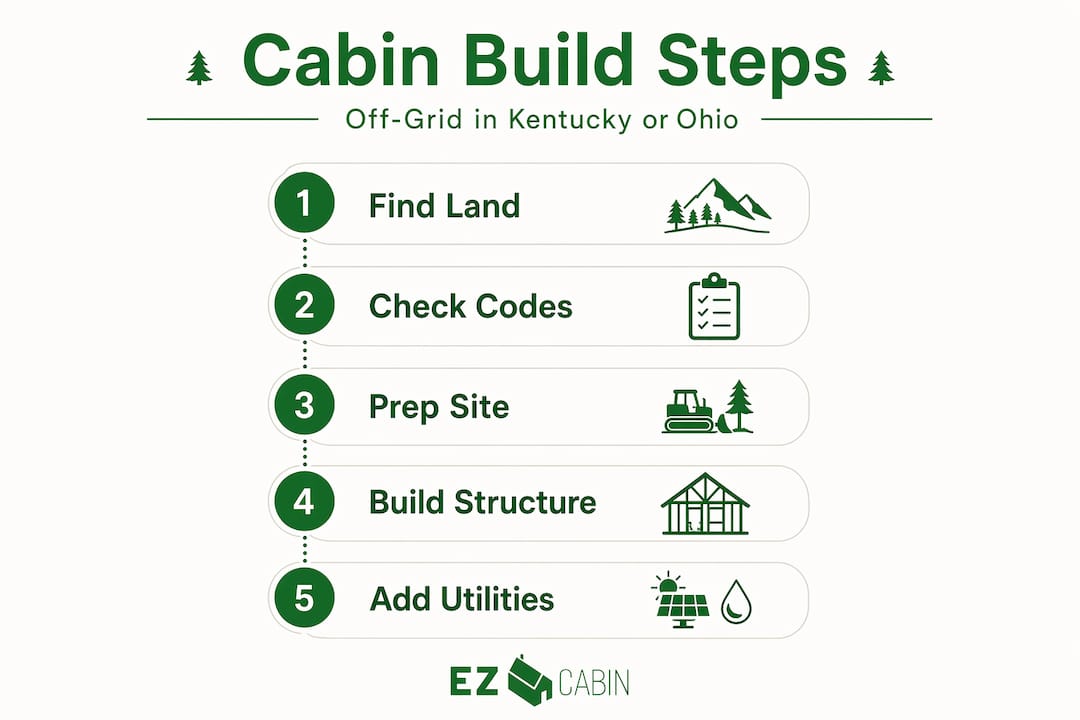
Kentucky vs. Ohio: A quick regulatory picture
Rural Kentucky counties tend to be more relaxed about small cabin builds. Owsley County, for example, has minimal zoning enforcement for structures under a certain square footage. That said, you still need septic approval through the local health department, and any structure intended for occupancy needs to meet the 2015 IRC. Ohio is notably stricter. The Ohio building code requires permits for nearly all new construction, and many counties mandate connections to municipal utilities even for rural parcels.
| Regulation area | Kentucky | Ohio |
|---|---|---|
| Building code standard | 2015 IRC with state amendments | Ohio Building Code (stricter) |
| Zoning enforcement | Varies widely by county | Generally more uniform statewide |
| Septic approval | Required through county health dept | Required; stricter inspections |
| Rainwater collection | Generally allowed | Check local ordinance |
| Composting toilets | Allowed in some counties | Requires health dept approval |
| Off-grid utility tie-in | Not always required rurally | Sometimes mandated |
Before you break ground, pull the zoning map for your specific parcel, call the county health department about septic options, and get written confirmation of what permits are required.
Choosing your build site the right way
According to regional off-grid guidance, you should always run a percolation test, commonly called a perc test, before committing to a site. A perc test measures how fast your soil absorbs water, which determines whether a conventional septic or alternative system will work. Clay-heavy soils and steep slopes are your two biggest enemies. Clay drains poorly and can cause septic failure. Steep grades create erosion and foundation problems that compound over time.
Look for a site with southern exposure for passive solar gain, relatively flat terrain, and good tree coverage on the north and west sides to block winter wind. Also check FEMA flood maps for your parcel before you sign anything.
For a broader overview of cabin ownership considerations in the region, the cabin ownership guide covers key questions buyers and builders face across both states. If you want a full breakdown of Kentucky-specific portable building rules, the Kentucky building guide is worth reading before you finalize your plans.
Safety warning: Never skip the perc test or assume your soil is suitable based on appearance alone. Installing a septic system in unsuitable soil can result in failed inspections, mandatory system removal, and costly fines.
Materials, tools, and prepping for construction
Once your site is selected and permits are in motion, it's time to gather materials and tools. Being organized here saves you weeks of delays and hundreds of dollars in wasted trips.
Essential tools for a DIY cabin build
- Circular saw and miter saw
- Framing nail gun and compressor
- Level, tape measure, and chalk line
- Post hole digger or auger (for pier foundations)
- Skid steer or compact tractor (rent if needed for site grading)
- Safety gear: hard hat, eye protection, hearing protection, steel-toed boots
Material cost snapshot
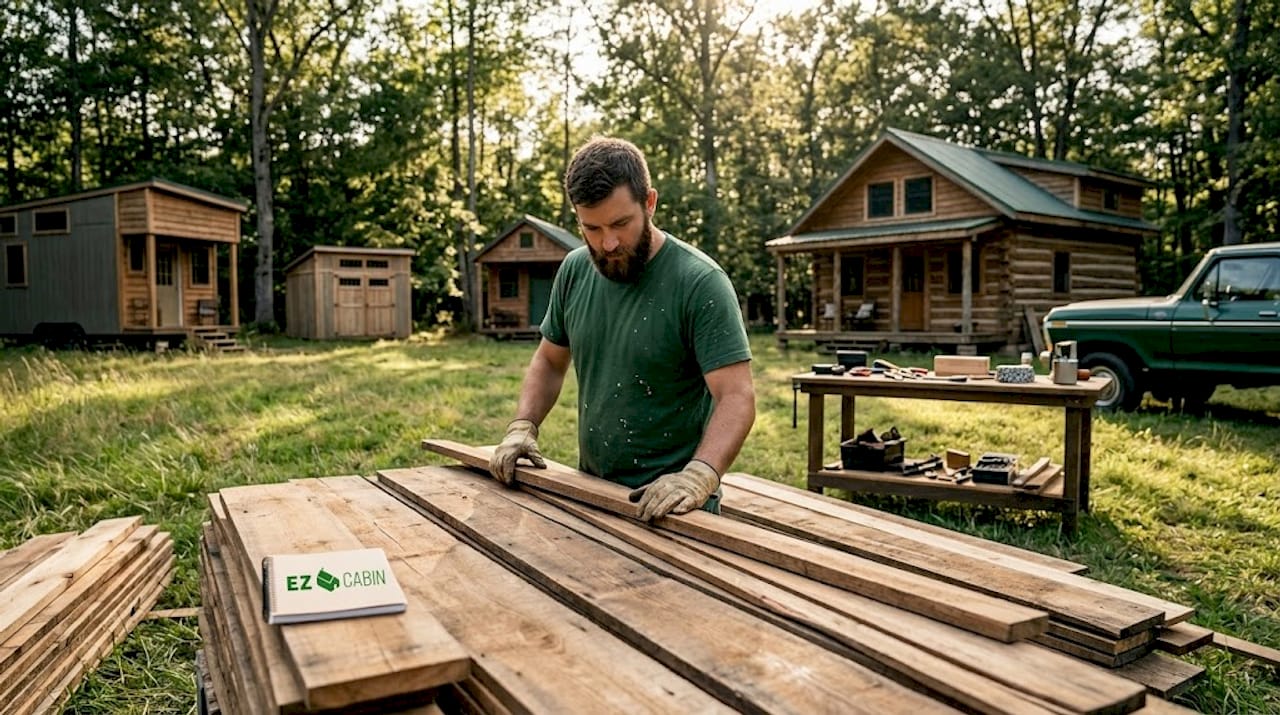
Per empirical build reports, a 14x20 foot cabin runs roughly $6,000 in materials using new lumber, while a 400 square foot build can come in around $2,000 if you source reclaimed components strategically. Those numbers assume you supply all the labor yourself.
| Material type | New cost estimate | Reclaimed cost estimate |
|---|---|---|
| Lumber (framing) | $1,800 to $2,500 | $400 to $900 |
| Roofing (metal) | $800 to $1,200 | $300 to $600 |
| Windows and doors | $600 to $1,000 | $100 to $400 |
| Insulation | $400 to $700 | Not typically reclaimed |
| Foundation piers | $300 to $600 | Similar cost either way |
Pro Tip: Call local barn demolition companies and salvage yards before buying any lumber. Kentucky and Ohio have active agricultural communities with a steady supply of old-growth barn wood that is often denser and stronger than new dimensional lumber, and it usually costs a fraction of the price.
The types of portable buildings available today give you a useful benchmark for comparing DIY material costs against prefab options. For design inspiration and functional layout ideas, browsing customizable cabins can also inform your own build decisions. When selecting exterior cladding or roofing, prioritize weatherproof materials rated for temperature swings, since Kentucky and Ohio both see significant seasonal variation.
Step-by-step cabin construction: foundation, framing, and weatherproofing
With your site prepped and materials staged, you're ready to build. Follow these steps in order. Skipping or rushing any stage creates problems that are expensive to fix later.
The core build sequence
According to the Off-Grid Cabin Build Guide, the standard construction process for a small off-grid cabin follows this sequence:
- Clear and grade the site. Remove all vegetation, roots, and topsoil from the footprint. Grade so water drains away from the structure on all sides.
- Set concrete piers below the frost line. In Kentucky and Ohio, frost depth typically ranges from 24 to 32 inches. Pour concrete tube forms at each corner and every 6 to 8 feet along the perimeter. Let them cure fully before loading.
- Build the rim and floor frame. Use pressure-treated lumber for the rim joist that contacts the piers. Frame the floor deck with 2x8 or 2x10 joists depending on your span, then sheath with 3/4-inch tongue-and-groove plywood.
- Frame the walls. Use 2x6 studs at 16 inches on center for better insulation capacity. Stand, brace, and sheathe each wall before moving to the roof.
- Frame and sheathe the roof. Use 2x6 rafters at the appropriate pitch for your design. A 6:12 pitch handles heavy snow loads common in eastern Kentucky and northern Ohio. Sheathe with OSB and add an ice and water shield membrane before roofing.
- Install metal roofing. Standing seam metal roofing is the most durable and long-term cost-effective choice for off-grid builds in this region. It handles ice, wind, and UV exposure well.
- Weatherproof the shell. Apply house wrap to all exterior walls before siding. Seal every penetration point: windows, doors, pipes, and electrical conduit entries.
Pro Tip: Use locally sourced cedar or pine for siding when possible. Kentucky-grown Eastern red cedar is naturally rot resistant, insect resistant, and typically available through small-scale local sawyers at competitive prices.
Important safety note: Foundation piers that are set above the frost line will heave during winter freeze cycles. Even a few inches of movement can rack your framing, crack your walls, and misalign your doors. Do not cut corners on depth.
The shed installation guide covers site prep and foundation placement in detail that applies directly to small cabin builds. If you are planning a structure that doubles as a workspace, the backyard office build guide has solid framing and insulation advice worth reading alongside this one.
Power, water, and waste: off-grid utilities for Kentucky and Ohio cabins
Getting your structure built is only half the project. Off-grid living depends on reliable, well-designed utility systems. Undersized solar, a failed well, or an improperly permitted septic system will ruin your off-grid experience fast.
Power: Solar PV with battery storage
Solar PV remains the primary power source for most off-grid cabins. A properly designed system typically uses 5 to 15kW of panels paired with 30 to 100kWh of LiFePO4 battery storage, giving you 2 to 3 days of autonomy through cloudy stretches. You'll also want an MPPT charge controller and a quality off-grid inverter. Propane backup generators are common for winter when solar production drops. Reviewing a solar battery setup before purchasing helps you avoid oversized or undersized systems.
| System component | Typical size for small cabin | Notes |
|---|---|---|
| Solar panels | 5 to 10kW | More is better in cloudy months |
| Battery bank | 30 to 60kWh LiFePO4 | 2-3 days autonomy |
| Charge controller | MPPT type | More efficient than PWM |
| Inverter | 3,000 to 5,000W | Off-grid rated |
| Backup generator | Propane, 3,500 to 7,000W | Winter insurance |
Water: Collection, wells, and filtration
Rainwater collection systems store 500 to 2,000 gallons and work well for non-potable uses. For drinking water, a drilled well with UV filtration and a sediment pre-filter is the most reliable option in Kentucky and Ohio. Two people typically use 25 to 40 gallons per day. Gravity-fed or solar-powered pumps move water without grid power. An off-grid water filter rated for bacteria and protozoa adds an important safety layer.
Waste: Composting toilets and septic
Composting toilets are preferred for true off-grid builds because they require no water or plumbing connections. For greywater from sinks and showers, a permitted septic system or greywater garden may be required. Kentucky requires a soil perc test before any septic permit is issued. Check out composting tips to understand how toilet composting systems actually work before buying one. For septic design and installation, consult a licensed professional and review septic system installation standards early.
Heat: Wood stoves, propane, and passive solar
Wood stoves remain the most practical heating option for most Kentucky and Ohio off-grid cabins. They require 36 inches of clearance or code-compliant shields around them. Propane heaters work well as backup or primary heat in smaller spaces. Passive solar design, meaning large south-facing windows and thermal mass floors, can significantly cut your heating load at zero operating cost.
Pro Tip: Size your south-facing window area to roughly 7 to 12 percent of your floor area for effective passive solar gain without overheating in summer.
The backyard cabin guide breaks down how people across Kentucky and Ohio are using small structures for sustainable year-round living.
Build methods, timelines, and real-world cost benchmarks
Understanding your options before committing to a build method saves you from expensive mid-project pivots.
Full DIY vs. prefab kit: A realistic comparison
| Factor | Full DIY from scratch | Prefab kit build | Prefab delivered |
|---|---|---|---|
| Total material cost | $2,000 to $8,000+ | $5,000 to $15,000 | $8,000 to $30,000+ |
| Skill level needed | High | Moderate | Low |
| Timeline to completion | 3 to 12 months | 6 weeks to 4 months | 1 to 4 weeks |
| Permit complexity | Full permit required | Often still required | Varies by county |
| Customization | Total | Moderate | High with AI tools |
Empirical build reports confirm that material costs for a 14x20 foot cabin run about $6,000 with new lumber, while experienced builders using reclaimed materials can complete a 400 square foot cabin for roughly $2,000. Labor is the wildcard. A solo builder working weekends might take 6 to 12 months to finish what a crew of three could complete in 6 to 8 weeks.
Biggest mistakes to avoid
- Starting construction before permits are issued
- Underestimating insulation needs for Ohio winters
- Using undersized rafters or joists to save money
- Skipping a vapor barrier under the floor frame
- Buying a solar system without a proper load calculation
If cabin financing choices are part of your planning, it's smart to map out your total project cost including utilities before you commit to any financing structure.
Our take: What most off-grid cabin guides miss in Kentucky and Ohio
Here's the uncomfortable reality: most off-grid cabin guides treat compliance as optional. They quietly imply that rural land means no rules. That is wrong, and it gets builders into serious trouble.
We've seen projects in rural Kentucky that skipped permits, installed undersized septic systems, and had no documentation for their structures. When the property was sold or inherited, the buyers faced mandatory teardowns and rebuild costs that far exceeded what the original permits would have cost. Compliance is not bureaucratic red tape. It's the foundation of a structure you can actually own, sell, and pass on.
On the solar side, many guides still recommend lead-acid battery banks because they are cheap upfront. But LiFePO4 batteries deliver 3,000 to 4,000 cycles compared to 500 to 700 for lead-acid, and they allow deeper discharge without damage. The math strongly favors LiFePO4 over a 10-year ownership horizon, even at double the initial cost. NEC 690 compliance applies to off-grid solar installations too, and ignoring it can create insurance and resale problems.
The other myth worth busting: prefab is not automatically easier for off-grid builds. A delivered structure still needs a proper foundation, permitted septic, and code-compliant utility connections. The convenience of prefab is real, but it does not eliminate your responsibility to handle site and utility compliance correctly.
For a thorough look at the full ownership picture, the deep-dive cabin ownership guide covers what smart buyers and builders need to know before, during, and after the build.
Next steps: Find off-grid cabin solutions in Kentucky or Ohio
Building your own off-grid cabin is one of the most rewarding projects you can take on. But between permits, utility systems, framing, and finishing, the work adds up fast. If you want a shortcut to the structure itself while still controlling the land and utility setup, EZ-Cabin gives you a practical path forward.
You can build your own cabin using our AI-powered design tool, which lets you adjust layouts, exterior colors, window placements, and functional upgrades in real time before you buy. No guessing what your cabin will look like. No waiting months for a quote. Financing is available with guaranteed approval and no credit check required, so getting started only takes your first month's payment. Browse our full inventory of cabins and sheds online or visit us in London, KY or Somerset, KY to see the structures in person. Most buildings are delivered within 1 to 4 weeks.
Frequently asked questions
Do Kentucky and Ohio require permits for off-grid cabin builds?
Yes. Both states require permits, zoning compliance, septic approvals, and adherence to building codes; Kentucky uses the 2015 IRC with state amendments while Ohio enforces its own stricter statewide code.
What's the typical cost for a small off-grid cabin using reclaimed materials?
A 400 square foot cabin can cost around $2,000 in materials when you use reclaimed components and supply all your own labor, according to real-world build benchmarks.
How much solar power do I need for a basic off-grid cabin?
Most small cabins run on 5 to 15kW of solar panels paired with 30 to 100kWh LiFePO4 batteries, which provides 2 to 3 days of autonomy without sun.
What are top off-grid waste options for rural cabins?
Composting toilets are the preferred choice for off-grid cabins since they need no water or plumbing, though greywater septic systems are often still required and need a soil perc test in Kentucky.
Is it better to build a cabin from scratch or buy a prefab kit in Kentucky or Ohio?
Prefab kits cut construction time significantly but still require permits and site prep; full DIY builds offer more customization at lower material cost but demand more skill, time, and code knowledge.