
TL;DR:
- Building permits and site regulations vary locally and require careful verification before construction.
- Costs range from $3,000 for DIY shell to over $30,000 for fully finished professional offices.
- Proper insulation, vapor barriers, and regional climate considerations are crucial for year-round comfort and durability.
Working from a bedroom corner or a noisy kitchen table gets old fast. If you're a remote worker or small business owner in Kentucky or Ohio, you've probably dreamed about having a real, dedicated workspace right in your backyard. Research shows that productivity jumps 30 to 40% when you work in a space dedicated exclusively to business use, and that space may even qualify for a tax deduction. The challenge is that turning that dream into reality means navigating permits, local codes, climate considerations, and a long list of construction decisions. This guide walks you through every step so you can build with confidence.
Table of Contents
- What to check before you build: Permits, zoning, and site selection
- Essential tools, materials, and cost breakdown
- Step-by-step: Building your backyard office in Kentucky or Ohio
- Common mistakes (and how to avoid them): Permits, comfort, and safety%3A-permits%2C-comfort%2C-and-safety)
- A veteran builder's take: What really matters for backyard offices in KY & OH
- Turn your backyard office vision into reality: Explore EZ-Cabin solutions
- Frequently asked questions
Key Takeaways
| Point | Details |
|---|---|
| Permit essentials | Smaller sheds may not need building permits, but all require checking zoning and always need permits for electrical work. |
| Cost factors | DIY builds can start around $3,000 while pro builds with HVAC and interior finish can reach $30,000. |
| Insulation priority | Proper insulation and moisture protection are crucial for comfort and longevity in Kentucky and Ohio climates. |
| Step-by-step approach | Following a clear sequence from permits to finishing ensures a legal, comfortable, and lasting backyard office. |
| Avoiding mistakes | Invest in the right permits, insulation, and pro help for electrical/HVAC to avoid expensive errors. |
What to check before you build: Permits, zoning, and site selection
Before you purchase materials or pick up a hammer, you'll need to handle site and legal essentials. Skipping this step is the fastest way to end up with a fine or, worse, an order to tear down a structure you just spent weeks building.
Start with your local zoning office
All rules begin with your city or county zoning and planning department. Zoning laws vary widely, even within Kentucky and Ohio. A rule that applies in Lexington may be completely different in a rural county. Call or visit your local office before you do anything else.
Permit thresholds
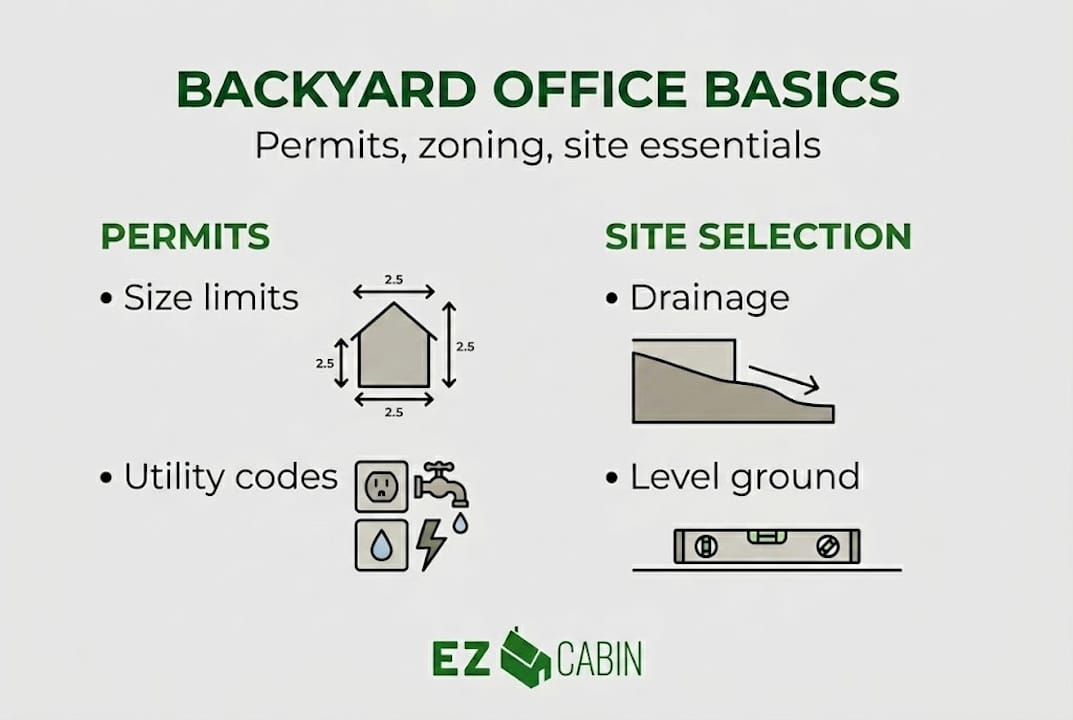
Here's the practical reality: backyard offices under 120 to 200 sq ft often don't require a full building permit in Kentucky, depending on whether your property falls under residential or state building code jurisdiction. Ohio has similar thresholds, though again, county rules can differ. However, size is only part of the picture.
Electrical and plumbing work always require separate permits, no matter how small the structure. Even if your 100 sq ft office shed skips the building permit entirely, the moment you run a wire or a waterline to it, you need to pull the appropriate permits.
Setbacks, HOAs, and edge cases
Setback rules (the required distance between your structure and property lines) are standard almost everywhere. A typical setup in Kentucky and Ohio requires at least 5 feet from side property lines and 10 feet from the rear line. Front yard placement is usually not allowed.
Beyond basic setbacks, watch for these situations:
- HOA restrictions: Many neighborhoods in Kentucky and Ohio have homeowner associations that impose stricter rules than the county, covering aesthetics, size limits, and placement.
- Flood zones: If your property sits in a FEMA flood zone, your structure may need to be elevated. Check your flood map before selecting a site.
- Corner lots: These often carry extra setback requirements on both street-facing sides.
- Prefab and portable structures: A prefab or portable cabin still follows the same rules as a stick-built structure. The fact that it could theoretically be moved does not exempt it from zoning or permit requirements.
Important: Always verify rules directly with your local planning department. Online summaries are helpful for orientation, but your municipality's office is the final word.
Pro Tip: When you call your zoning office, ask specifically whether your structure will be classified as a "residential accessory structure." That classification often unlocks the most favorable permit thresholds.
Choosing the right spot in your yard
Good site selection saves you money and headaches later. Look for level ground with good drainage. Low spots collect water, and that spells trouble for foundations and moisture control. Position your office to take advantage of natural light without creating glare on your monitor. North or east-facing windows tend to be the most practical for screen work. You can read more about zoning and permitting steps before committing to a spot.

Essential tools, materials, and cost breakdown
Once you're clear on legal requirements, you need to understand what's involved and what it costs. A backyard office is not just a storage shed with a desk dropped inside. Comfort, insulation, and power are what separate the two.
Core materials and systems
When you're scoping out a build, these are the major categories to plan for:
- Framing lumber: Pressure-treated 2x4s or 2x6s for walls, floor joists, and roof rafters
- Sheathing and siding: OSB for structural sheathing, with LP SmartSide, vinyl, or T1-11 for exterior finish
- Roofing: Asphalt shingles are the most common and affordable choice for Kentucky and Ohio
- Insulation: Fiberglass batts, rigid foam, or spray foam (more on this later)
- Vapor barrier: 6-mil poly sheeting, especially important for the floor and walls in humid climates
- Windows and doors: At minimum, one egress window and a solid exterior door
- Electrical rough-in: Wire, outlets, a sub-panel or circuit breaker, and proper conduit
- HVAC: A mini-split system is the gold standard for a small office space
For a deeper look at the options available, check out this breakdown of comparing office shed types to figure out what style fits your needs best.
Real cost numbers
One of the most common questions is: What will this actually cost me? The honest answer is that it depends heavily on size, finish level, and whether you hire out the work. A 120 sq ft office shed lands in a wide range, as shown below.
| Build approach | Estimated cost range | What's typically included |
|---|---|---|
| DIY materials only | $3,000 to $8,000 | Lumber, siding, basic insulation, materials |
| Full DIY with electrical and HVAC | $8,000 to $18,000 | All materials plus systems |
| Professional full build | $12,000 to $30,000+ | Labor, insulation, HVAC, electrical, finish |
Per square foot, costs run from about $20 on the low end (basic shell, no systems) to $150 on the high end (fully finished, climate-controlled, professionally built). Most homeowners in Kentucky and Ohio end up somewhere in the $15,000 to $22,000 range when they add insulation, a mini-split, and licensed electrical work.
Understanding shed construction basics will also help you have smarter conversations with contractors if you decide to bring in professional help.
Step-by-step: Building your backyard office in Kentucky or Ohio
With your gear ready, here's how a typical backyard office comes together, broken down step by step.
The full build sequence
- Verify permits, zoning, and site selection. Confirm everything with your local planning office. Get written confirmation where possible.
- Choose and prepare your foundation. This is one of the most consequential decisions you'll make.
- Frame your walls and roof. Use pressure-treated lumber for anything touching or near grade. Standard framing with 16-inch on-center spacing is typical.
- Install siding, roofing, windows, and doors. Get the building weather-tight before moving to interior work.
- Insulate walls, floor, and ceiling. Target at least R-13 for walls. R-19 or higher for the ceiling. Use fiberglass batts or spray foam depending on your budget.
- Run electrical wiring. Hire a licensed electrician. A typical home office needs at least a 20-amp circuit, and ideally two.
- Finish the interior. Drywall, tongue-and-groove paneling, or even plywood can all work well depending on your aesthetic.
Foundation options compared
| Foundation type | Best for | Pros | Cons |
|---|---|---|---|
| Gravel piers | Sloped or soft ground | Affordable, good drainage | Less stable long-term |
| Concrete slab | Flat ground, permanent builds | Most durable, great for HVAC | Higher upfront cost |
| Deck blocks | Flat ground, smaller structures | Fast, affordable, no digging | Limited for heavy loads |
A concrete slab is the best long-term investment for a year-round office. Deck blocks work fine for a smaller structure you might want to relocate later.
Why insulation matters more in Kentucky and Ohio than you might expect
Kentucky and Ohio sit in a climate zone that swings hard in both directions. Summers are humid and hot, winters are cold and damp. Insulation and a vapor barrier are the two elements that separate a year-round office from a structure you abandon every July and January. Moisture that gets into wall cavities without a vapor barrier causes mold, rot, and eventually structural damage.
Pro Tip: When finishing your interior, run a hardwired ethernet cable to your desk area during the rough-in phase. It's cheap to add before the walls close up, and hardwired internet is significantly more reliable than Wi-Fi for video calls.
For those weighing a full DIY approach against a prefab structure, a full DIY build overview lays out what each path actually involves.
Common mistakes (and how to avoid them): Permits, comfort, and safety
Even with a clear step plan, it's easy to overlook critical details. Here's how to sidestep the pitfalls that trip up most first-time backyard office builders.
Permit violations
Skipping permits is tempting when you're trying to save time and money. Don't do it. Non-compliance with local zoning can result in fines, stop-work orders, or a requirement to remove the structure entirely. Beyond the financial hit, an unpermitted structure can complicate your homeowner's insurance and your ability to sell the property later.
Moisture and insulation failures
This is the single most common technical mistake in Kentucky and Ohio builds. People treat their backyard office like a storage shed and skip the vapor barrier. Within one or two humid summers, the interior starts showing moisture damage, condensation, and eventually mold.
Moisture control in humid Midwest climates requires a two-part approach: proper insulation AND a vapor barrier. One without the other is not enough. Pair both with a mini-split system and you'll have a space that stays comfortable through Kentucky summers and Ohio winters alike.
Key mistakes to avoid:
- Skipping the vapor barrier on the floor slab or crawl space
- Using the wrong insulation R-value for the climate zone
- Leaving gaps around windows and doors that let in air and moisture
- Using unfaced insulation in spaces where facing adds an important moisture layer
Electrical and HVAC shortcuts
Electrical and HVAC systems add 30 to 50% to your total project cost, which is why some people try to cut corners here. Running electrical yourself without a permit is a serious safety risk and creates a major liability. Hire licensed contractors for both.
Bottom line: An unpermitted electrical system that causes a fire is not covered by most homeowner's insurance policies. That risk is never worth the savings.
Comfort oversights people regret
Beyond structural basics, these are the comfort details that matter:
- Window placement: East-facing windows provide morning light without the afternoon glare that destroys monitor visibility
- Sound leaks: Thin walls and unsealed gaps let in lawn mower noise, neighbor noise, and traffic, which kills focus during calls
- Lighting plan: A single overhead bulb is not enough. Plan for task lighting and a warm ambient layer
For a complete look at how these elements come together for livable spaces, see the guide on making sheds livable.
A veteran builder's take: What really matters for backyard offices in KY & OH
Here's something most guides won't tell you plainly: the biggest regrets we hear from Kentucky and Ohio homeowners are almost never about the things they spent money on. They're about the things they skipped.
Insulation and permits top that list every time. A homeowner who cuts corners on insulation thinking "I'll add it later" almost never does, because adding it later means tearing out interior walls. And the homeowner who skips permits to save a few hundred dollars sometimes ends up paying thousands in fines or losing a sale because the structure can't be disclosed properly.
The surprising insight we'd offer is about soundproofing. Most people focus their upgrade budget on flooring or aesthetics. But the single most impactful upgrade for a working office, the one that actually changes how productive the space feels, is acoustic treatment. Even basic acoustic panels on the walls and a solid-core door make a dramatic difference. You stop being jarred out of focus by outdoor noise. Your video call audio sounds professional. It's not glamorous, but it pays off every single day.
On the DIY vs. prefab question for this region specifically: Kentucky and Ohio winters are not forgiving. A prefab structure from a quality supplier that's already insulated and built to handle regional climate conditions will typically outperform a rushed DIY build for year-round comfort. The build quality is consistent, the timeline is predictable, and the insulation specs are already matched to the climate. For most homeowners, affordable backyard office options that combine prefab convenience with quality materials make more practical sense than starting from scratch.
The office you'll actually use year-round is not the fanciest one. It's the one that's warm in February, cool in August, quiet enough to think in, and completely legal to operate in.
Turn your backyard office vision into reality: Explore EZ-Cabin solutions
You've done the research. Now the question is how to make it happen without months of contractor calls and cost surprises.
At EZ-Cabin, we've helped hundreds of Kentucky and Ohio homeowners get from "I want a backyard office" to "I'm working in it" in just a few weeks. You can browse backyard offices and sheds in our online inventory and use our AI customization tools to adjust layouts, colors, windows, and doors in real time before you commit. Our financing options require no credit check and just your first month's payment to get started. Most buildings are delivered within one to four weeks. Want to see real results before you decide? Browse customer backyard office photos from real Kentucky and Ohio homeowners to get inspired.
Frequently asked questions
Do I need a permit to build a backyard office in Kentucky or Ohio?
Backyard offices under 120 to 200 sq ft typically don't require a building permit, but permits are always required for any electrical or plumbing work regardless of the structure's size.
How much does it cost to build a backyard office in KY/OH?
DIY materials run $3,000 to $8,000 for a basic 120 sq ft build, while a professionally installed office with HVAC and electrical typically costs $12,000 to $30,000 or more.
What type of foundation works best for backyard offices?
A concrete slab offers the most durability and is the best choice for a permanent year-round office, while gravel piers or deck blocks work for smaller or potentially relocatable structures.
Why is insulation and vapor barrier so important for Kentucky and Ohio?
The humid summers and cold winters in this region mean that moisture control is essential to prevent mold and structural damage, and insulation alone won't solve it without a proper vapor barrier working alongside it.