
TL;DR:
- Buying a portable cabin involves complex legal, financial, and zoning considerations that vary by state and land ownership type.
- Understanding whether a cabin is personal property or real estate, based mainly on foundation and attachment, affects financing, taxes, and transfer procedures.
Buying a portable cabin sounds straightforward until the questions start piling up. Is it considered real estate? Can you get a regular mortgage on it? What if you park it on rented land, or share ownership with a sibling? For buyers in Kentucky and Ohio, the answers depend on a surprisingly detailed mix of property law, lender rules, and local zoning codes that most sellers never bother to explain. This guide cuts through that confusion and gives you the practical, state-specific knowledge you need to make a smart decision before you sign anything.
Table of Contents
- Understanding types of cabin ownership
- Financing and lender requirements: How to qualify for a mortgage
- Legal and zoning rules in Kentucky and Ohio: What you must know
- Co-ownership and deed: What happens if you share or inherit a cabin in Kentucky
- What most guides miss: Planning for flexibility and long-term value
- Take the next step with EZ-Cabin
- Frequently asked questions
Key Takeaways
| Point | Details |
|---|---|
| Ownership type matters | Real property vs. personal property changes what you can do and affects your rights. |
| Financing depends on structure | Lenders want foundations and minimum size—portable cabins may need specialized loans. |
| Zoning rules can limit use | Check local ADU and occupancy rules before committing to a cabin investment. |
| Deed language affects inheritance | In Kentucky, what your deed says can change how ownership passes after death. |
| Future-proof with flexibility | Plan ahead for regulatory changes by choosing the right structure and documentation. |
Understanding types of cabin ownership
With that foundation in mind, let's clarify the two main types of cabin ownership and why it matters so much for buyers in this region.
When you purchase a portable cabin, you are not automatically a real estate owner. The law draws a sharp line between personal property and real property, and where your cabin lands on that spectrum shapes everything from how you pay taxes to what happens when you sell.
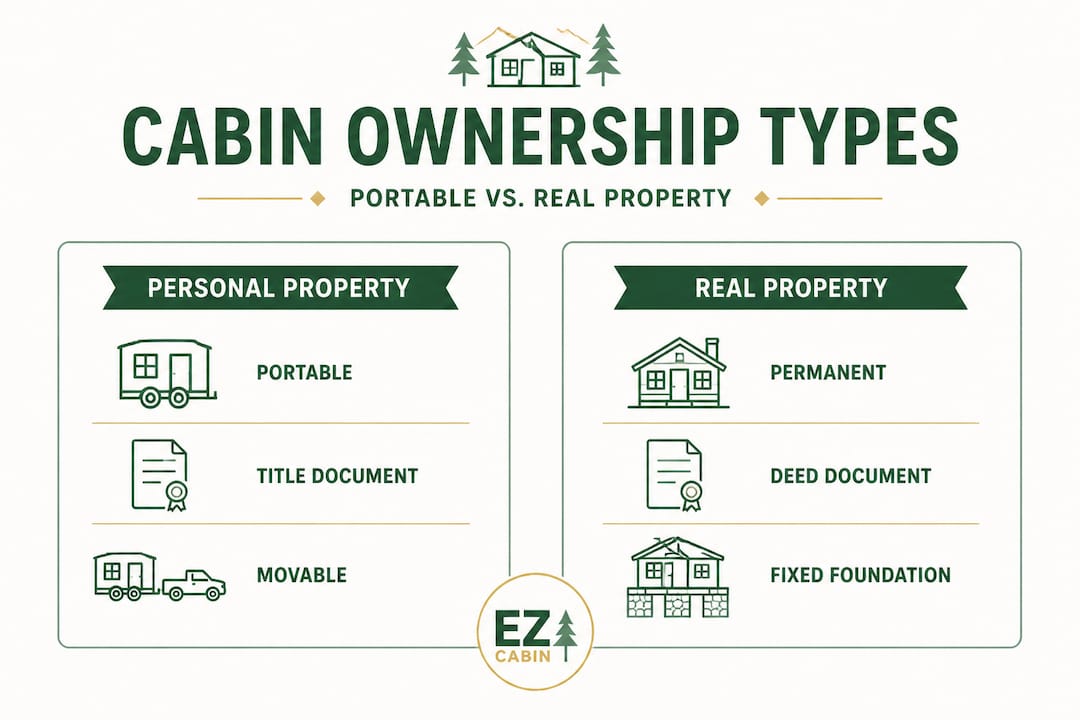
Personal property means the cabin is movable and titled much like a vehicle. You receive a certificate of title from the state, and the structure can be relocated. Real property means the cabin has been permanently affixed to land you own, recorded with a deed, and converted from a titled structure into a piece of real estate. As ownership can differ materially between a state-issued title (personal property) and a deed (real property) once a structure is affixed to land, that single decision affects your legal rights in a big way.
The determining factor is almost always the foundation. A cabin sitting on concrete piers that could be removed and moved stays personal property. A cabin bolted to a permanent perimeter foundation, with the axle removed and the title surrendered, becomes real property in most cases under Kentucky and Ohio law.
Why does this matter in practice? Real property can be financed with a traditional mortgage, qualifies for homestead exemptions on property taxes, and passes through your estate via a deed. Personal property gets financed differently, taxed differently, and transferred differently. Both paths can lead to affordable living and investment opportunities, but only if you choose the right one for your situation from the start.
Common misconceptions buyers bring to the table:
- A cabin on rented land can become real property (it generally cannot, because you don't own the land)
- Adding plumbing or electricity automatically upgrades a cabin to real property (it does not)
- A portable cabin always avoids property taxes (most counties assess personal property annually)
- A deed means you own the cabin free and clear (a deed conveys real property status, not debt-free status)
- Portable cabins can't be used as collateral (they often can, just through different loan products)
| Feature | Personal property cabin | Real property cabin |
|---|---|---|
| Foundation type | Portable or temporary | Permanent, affixed |
| Ownership document | State-issued title | Deed recorded with county |
| Financing type | Personal loan, chattel loan | Conventional or FHA mortgage |
| Property tax treatment | Personal property tax | Real estate tax |
| Transferability | Easier to move and sell quickly | Tied to land transaction |
| Homestead exemption | Generally not eligible | Eligible in most counties |
For a broader look at portable building options in the region, the Kentucky portable buildings guide breaks down what buyers are actually choosing and why.
Pro Tip: Before buying, ask the seller to clarify what documentation you will receive. A title versus a deed changes your entire ownership experience.
Financing and lender requirements: How to qualify for a mortgage
Having defined ownership, let's address the next big hurdle: paying for your cabin, and how lender rules shape your choices.
Most buyers assume a cabin is just a smaller, cheaper house that banks will happily finance. In reality, lenders apply strict criteria that many portable structures simply cannot meet. The core issue is that tiny home financing eligibility often depends entirely on whether the unit is treated as a permanent structure on a foundation and whether it qualifies for real-property status under lender guidelines.
Here is what lenders typically require for a conventional or FHA mortgage on a small structure:
- The unit must rest on a permanent foundation
- The foundation must meet local building codes
- The structure must qualify as real property with a recorded deed
- Minimum square footage usually falls between 320 and 400 square feet
- The property must be owner-occupied or meet investment property criteria
Portable cabins that are 12x24 feet (288 sq ft) or smaller often fall short of the square footage threshold alone. That rules out a standard mortgage before the foundation question even comes up.
| Lender requirement | Standard portable cabin | Affixed real-property cabin |
|---|---|---|
| Permanent foundation | Often not met | Met |
| Real-property status | Often not applicable | Met |
| Minimum square footage (320+ sq ft) | Varies, often not met | Usually met if designed for it |
| Mortgage eligibility | Generally no | Often yes |
| Alternative financing available | Yes (chattel, personal loan, RTO) | Yes (plus conventional options) |
So what do buyers do when a standard mortgage isn't available? Several practical options exist:
- Chattel loans: These are personal property loans specifically designed for mobile and manufactured structures. Interest rates run higher than mortgages, but approval criteria are less rigid.
- Personal loans: Unsecured loans work for smaller cabin purchases, though limits apply.
- Rent-to-own programs: You make monthly payments toward ownership without needing upfront financing approval. More details on how this works for small structures are in the financing tiny homes breakdown.
- Land plus structure financing: If you own land and plan to permanently affix the cabin, some lenders will bundle land and structure into one loan.
- Seller-backed financing: Some retailers offer their own financing programs with fewer requirements than a traditional bank.
For a focused look at how this plays out locally, the cabin financing options resource covers Kentucky and Ohio-specific programs and what buyers should ask lenders upfront.
Pro Tip: Pull together your land documents, site address, and planned foundation type before approaching any lender. Walking in prepared cuts approval time significantly and signals to lenders that you're a serious buyer.
Legal and zoning rules in Kentucky and Ohio: What you must know
Once you've figured out the financial side, the next critical step is making sure your cabin plans won't hit a wall with local regulations.
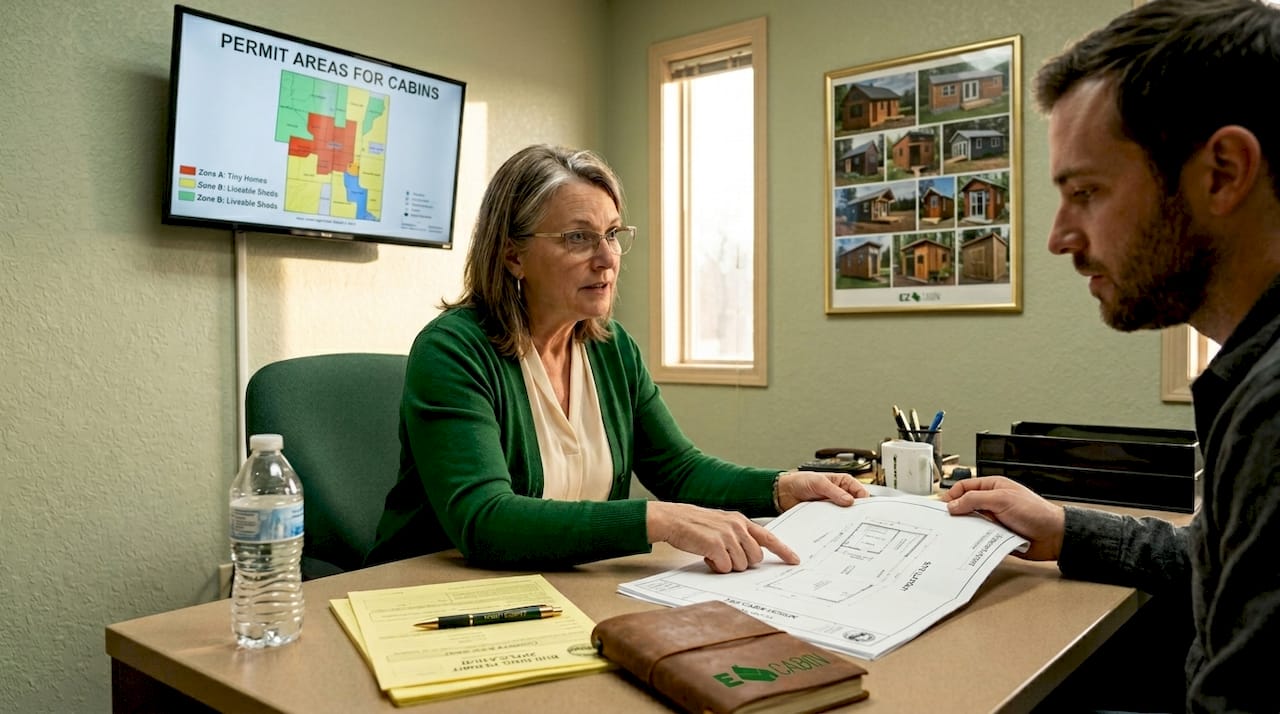
Zoning laws in Kentucky and Ohio are not uniform. State rules set a baseline, but counties and municipalities add their own layers. A cabin that's perfectly legal in rural Laurel County, Kentucky may face steep restrictions in a suburban township in Ohio. This is the piece most buyers discover too late.
ADUs (accessory dwelling units) are the most relevant zoning category for backyard or secondary cabins. Ohio cities implement ADU owner-occupancy and size limits; Cincinnati, for example, permits ADUs in single-family zones only under specific conditions including owner-occupancy, maximum size, and separate entrance requirements. Falling outside those conditions means the cabin cannot legally serve as a dwelling unit, even if it's beautifully finished.
Cincinnati ADU standards require the ADU to be owner-occupied, limited in size, and accessed through a separate entrance. These rules are typical of Ohio cities trying to balance housing density with neighborhood character.
Top legal factors to check before placing a cabin on your property:
- Local zoning classification (residential, agricultural, commercial)
- Whether the land allows ADUs or accessory structures
- Minimum setback distances from property lines and neighbors
- Permit requirements for electrical, plumbing, and foundation work
- Occupancy restrictions (seasonal use vs. year-round habitation)
- Whether the county recognizes portable structures as dwellings at all
The Ohio portable building guide walks through the permit process in detail, which is essential reading before you finalize a site. For Kentucky buyers, the backyard cabin uses article covers what people are actually doing with their structures and where local rules push back.
If income is part of your plan, for example renting out the cabin, the rules get even more specific. The affordable rental units guide addresses what landlords need to know before listing a cabin-based rental.
Pro Tip: Call your county's planning and zoning office before purchasing. One 15-minute conversation can confirm whether your planned use is allowed, what permits you need, and whether any variance process applies. This call costs nothing and can save thousands.
Co-ownership and deed: What happens if you share or inherit a cabin in Kentucky
Legal occupancy is only part of the puzzle. For those sharing or planning to pass down a cabin, it's crucial to understand co-ownership details, especially in Kentucky.
Many cabin purchases involve two or more people. Maybe it's siblings splitting the cost of a family retreat, or a couple buying together without being married. Whatever the setup, Kentucky law has a default position that surprises most people. Kentucky presumes tenancy in common unless the deed specifically creates a joint tenancy or tenancy by the entireties.
What's the difference? With tenancy in common, each owner holds a separate fractional share. When one owner dies, their share passes to their heirs, not automatically to the other owner. With joint tenancy with right of survivorship, the surviving owner inherits the deceased owner's share directly, bypassing probate. Tenancy by the entireties is reserved for married couples and offers the strongest protections against creditors.
Getting this wrong creates real problems. Imagine co-buying a cabin with your brother, assuming he inherits your share if something happens to you, only to have your share pass to your children instead because the deed said "tenants in common." Suddenly your brother co-owns a cabin with your kids, and nobody wanted that outcome.
How to make sure your deed is set up correctly:
- Hire a real estate attorney in Kentucky to draft or review the deed before signing.
- Confirm the exact language used to describe the ownership type.
- Decide explicitly whether you want survivorship rights between co-owners.
- If married, ask whether tenancy by the entireties applies and whether it's appropriate.
- Review the deed again if any owner's circumstances change, such as marriage, divorce, or death in the family.
- Store a certified copy of the deed in a secure location separate from the property itself.
Pro Tip: Never assume the deed language reflects your intentions. Read it word for word, or have an attorney read it for you. The difference between "and" and "or" in ownership language can determine who inherits your share.
What most guides miss: Planning for flexibility and long-term value
Here is a truth that most cabin articles skip over entirely. The buyers who get the most value from their structures are the ones who plan for change rather than just planning for the moment of purchase.
Zoning codes shift. Cities that allowed ADUs freely five years ago are now adding owner-occupancy requirements and size caps. What's permissible today in a given Ohio township may be restricted in two years. Buyers who designed their cabins with flexible, upgradeable infrastructure from the start, including proper electrical panels, plumbed rough-ins, and foundation-ready framing, can adapt when rules change. Buyers who built to the bare minimum often can't.
The same logic applies to financing. If you design your cabin for real-property status from day one, meaning permanent foundation, adequate square footage, title surrender, you preserve the option to refinance into a conventional mortgage later. That flexibility has a real dollar value. A structure that qualifies as real property typically appraises higher and attracts more buyers when you eventually sell.
Documentation is another area where cabin owners consistently fall short. Every major upgrade, every permitted addition, every inspection report should be filed and kept. Future buyers and lenders care deeply about what was done to a structure and whether it was done properly. An organized file of permits and receipts signals a well-maintained property and often speeds up the financing process for whoever buys from you.
We've seen the pattern repeat itself: buyers who explore cabin investment opportunities with a long-term lens almost always outperform those who treat the purchase as a short-term convenience. A cabin is a long-term asset. Treat it like one from the first day you own it.
Take the next step with EZ-Cabin
With a full picture of what's involved in owning a cabin, here's how you can move forward with confidence, backed by the right resources.
EZ-Cabin serves buyers across Kentucky and Ohio with portable, customizable buildings built for real-life uses: weekend retreats, backyard offices, rental units, and more. We've removed the friction that makes cabin buying complicated elsewhere.
Our cabin financing options include guaranteed approval with no credit check required, and you only need the first month's payment to get started. No long waits, no hidden fees. If you'd rather see the buildings in person before committing, visit our Kentucky and Ohio locations in London and Somerset, KY. Ready to browse inventory and customize your structure right now? Explore our full selection of rent-to-own cabins and use our AI-powered design tools to visualize exactly what you want before purchasing.
Frequently asked questions
Can I use a portable cabin as a full-time home in Ohio or Kentucky?
In many areas, local zoning and state rules limit portable cabins for full-time residential use, with ADU and building codes often imposing size, foundation, and owner-occupancy standards that portable structures may not meet without modification.
What financing options exist if a cabin isn't on a permanent foundation?
Portable cabins frequently don't meet regular mortgage criteria, but alternative lending options like chattel loans, personal loans, and rent-to-own programs are commonly available and designed specifically for these structures.
How do inheritance rules work if I co-own a cabin in Kentucky?
Unless the deed clearly states joint tenancy, Kentucky law treats co-owners as tenants in common, meaning your share passes to your heirs rather than automatically to the surviving co-owner.
Does size or square footage affect what I can do with a portable cabin?
Yes. Most lenders, cities, and counties impose minimum size requirements for permanent residences and ADUs, and meeting square-footage conditions is often required before a structure qualifies for traditional financing or legal occupancy as a dwelling.
Recommended
- Maximize Returns: Cabin Investment Opportunities in KY & OH
- Cabin financing options for KY and OH buyers
- Backyard cabin benefits: uses and value in KY and OH
- Customizable cabins for affordable living and investment
- Who Regulates HVAC in Kentucky? 2025 Guide for Property Owners - HVAC Service and Repair | Louisville, KY | Project Heating & Cooling