
TL;DR:
- Cabin and portable building investments in KY and OH offer high returns with lower upfront costs.
- Regulations, zoning, and tax classifications vary locally, requiring thorough due diligence.
- Successful investors focus on high occupancy, strategic upgrades, and effective management.
Most people assume real estate investing means a six-figure down payment, a mortgage approval process that takes months, and a property that ties up your capital for years. But cabin and portable building investments in Kentucky and Ohio are quietly rewriting those rules. Investors here are generating $17,000 to $30,000 annually from a single cabin, often with a fraction of the upfront cost of a traditional rental home. This guide breaks down exactly how these investments work, what the real numbers look like, which regulations you need to know, and how to position yourself to earn strong, consistent returns.
Table of Contents
- Why cabins and portable buildings make smart investments in KY & OH
- Understanding income potential: Real numbers from Kentucky & Ohio
- Navigating regulations, taxes, and ownership structures
- Smart strategies: Maximizing returns and avoiding pitfalls
- Our take: What most investors overlook about affordable cabins
- Ready to explore your investment opportunity?
- Frequently asked questions
Key Takeaways
| Point | Details |
|---|---|
| High returns achievable | Well-located cabins in Kentucky and Ohio can yield 8-40% gross return on investment. |
| Flexible investment options | Cabins and portable buildings are suitable for personal use, rentals, or mixed strategies. |
| Regulation requires attention | Short-term rental rules, local permits, and taxes affect legal operation and profits. |
| Cost control is crucial | Plan for maintenance, seasonality, and strategic upgrades to maximize profits. |
Why cabins and portable buildings make smart investments in KY & OH
Traditional rental properties in Louisville or Columbus can easily run $200,000 or more before you collect a single dollar in rent. A quality portable cabin or park model, on the other hand, can be purchased for a fraction of that cost and placed on land you already own or lease affordably. That lower buy-in changes the math entirely.
The appeal goes beyond price. Customizable cabins let you design a structure that fits your exact investment strategy, whether that means a cozy weekend getaway rental, a long-term tenant unit, or a personal retreat that doubles as a short-term rental when you are not using it. That flexibility is something a standard rental house simply cannot offer.
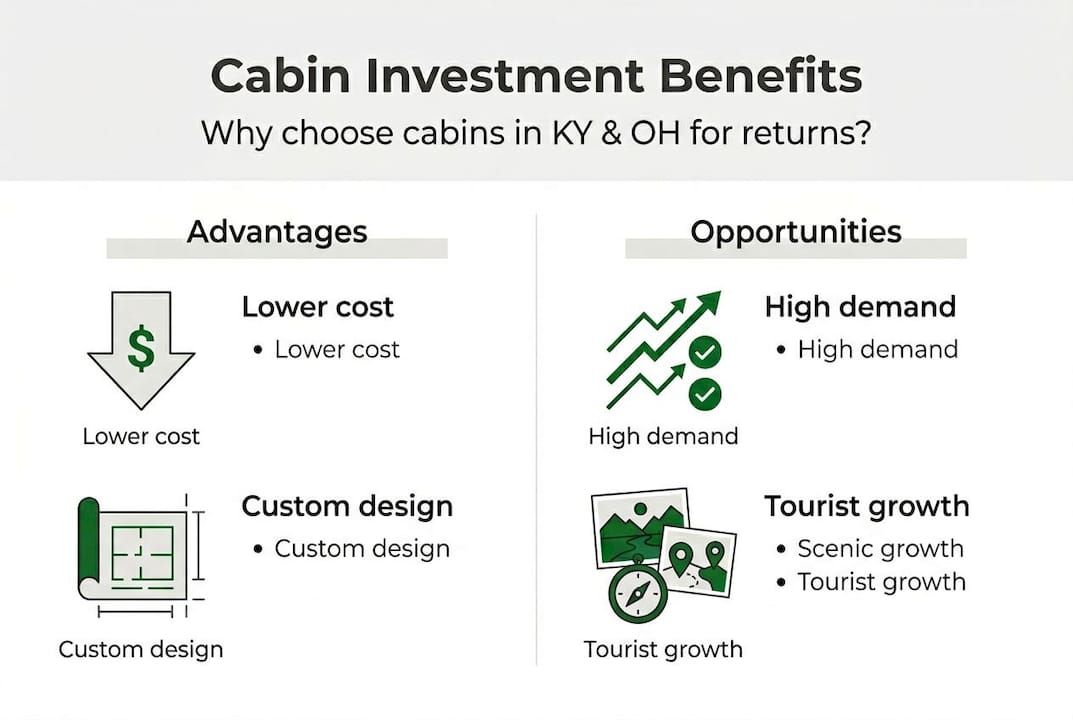
Region-specific demand also works in your favor. Kentucky's Red River Gorge, Cumberland Falls, and Lake Cumberland draw steady tourist traffic year-round. Ohio's Hocking Hills region is one of the most visited state park areas in the Midwest. Both states have a growing appetite for unique, nature-adjacent lodging that hotels cannot replicate.
Here is a quick comparison of cabin investments versus traditional rental properties:
| Factor | Cabin or portable building | Traditional rental home |
|---|---|---|
| Typical buy-in | $15,000 to $80,000 | $150,000 to $300,000+ |
| Setup time | 1 to 4 weeks | 30 to 90 days |
| Customization | High (design before purchase) | Limited post-purchase |
| Gross annual yield | 20% to 40% ROI | 5% to 10% ROI |
| Mobility | Portable in many cases | Fixed |
The backyard cabin benefits extend well beyond rental income too. Owners report increased property values, added functional space, and the option to convert the structure to personal use if market conditions shift.
- Lower barrier to entry means faster time to positive cash flow
- Portable structures can be relocated if a site underperforms
- Multiple use cases reduce vacancy risk compared to single-purpose rentals
- Shorter financing terms mean faster payoff and equity building
Pro Tip: If you are buying your first cabin investment, start with a single unit near a proven tourism corridor. Hocking Hills and Lake Cumberland have documented track records that make projections far more reliable than untested rural locations.
Understanding income potential: Real numbers from Kentucky & Ohio
Numbers tell the real story. A single well-placed cabin rental in Kentucky or Ohio can generate $17,000 to $30,000 per year in gross revenue. Scale that up and the picture gets even more compelling. A documented Hocking Hills portfolio of five cabins produces $180,000 or more annually with a cash-on-cash return of roughly 8.17%.

For context, cash-on-cash return measures how much cash income you earn relative to the cash you actually invested. An 8% cash-on-cash return means for every $100,000 you put in, you receive $8,000 in net cash per year. That is before appreciation and tax benefits.
Ohio short-term rentals yield 8% to 15% in total annual returns, which consistently outperforms many traditional asset classes. Park models classified as RVs have shown 20% to 40% ROI in favorable locations.
| Scenario | Investment | Gross annual income | Estimated ROI |
|---|---|---|---|
| Single cabin, Lake Cumberland | $45,000 | $17,000 | ~38% |
| Single cabin, Hocking Hills | $60,000 | $30,000 | ~50% |
| 5-cabin portfolio, Hocking Hills | $220,000 | $180,000+ | ~8% CoC |
| Park model RV rental | $35,000 | $10,000 to $14,000 | 20% to 40% |
"The Hocking Hills region consistently outperforms broader Ohio real estate benchmarks for short-term rental operators who manage their properties actively."
Of course, gross income is not net income. You need to account for platform fees if using Airbnb or Vrbo, cleaning costs, property management if you hire out, and seasonal dips. Winter months in both states can soften bookings unless you market specifically to hunters, holiday travelers, or remote workers seeking a quiet retreat.
To boost Airbnb profits meaningfully, operators focus on professional photography, fast response times, and amenities like hot tubs or fire pits that justify premium nightly rates. The affordable rental units guide walks through how to structure your unit for maximum appeal at each price point.
- Occupancy rates of 60% to 75% are realistic in proven tourism areas
- Nightly rates of $100 to $250 are common for well-presented cabin rentals
- Adding a hot tub can increase booking revenue by 20% or more
- Long-term rentals offer more stability but typically lower gross yields
Navigating regulations, taxes, and ownership structures
One of the most common mistakes new cabin investors make is assuming that what is legal in one county is legal in the next. Short-term rental regulations are local, meaning your city or county sets the rules, not the state. Kentucky does not have a statewide ban on short-term rentals, but Louisville and Lexington both have registration requirements and zoning restrictions that you must satisfy before listing.
In Ohio, Hocking Hills falls under Hocking County jurisdiction, which has historically been favorable to cabin rentals. However, you still need to verify zoning classification, setback requirements, and whether your parcel is approved for commercial lodging use.
Here is a step-by-step approach to staying compliant:
- Confirm your parcel's zoning classification with the county auditor before purchasing or placing a structure.
- Apply for a short-term rental permit if your city or township requires one.
- Register for Kentucky's 6% sales tax on lodging and any applicable local occupancy tax.
- Check whether your structure qualifies as an RV or park model, which may reduce or eliminate property tax obligations.
- Consult a local CPA or real estate attorney to choose the right ownership structure, typically an LLC, for liability protection.
The portable building types you choose can directly affect your tax classification. Structures built on a permanent foundation are generally treated as real property, while those on skids or wheels may qualify for personal property or RV classification. That distinction matters when calculating your annual tax burden.
Pro Tip: Setting up an LLC for your cabin rental costs relatively little but creates a legal firewall between your personal assets and any liability from guests. Pair that with a solid short-term rental insurance policy and you are well protected.
The prefab shed benefits article covers how non-permanent structures are treated differently from site-built construction across both states, which is useful background when speaking with your county assessor.
- Always get zoning confirmation in writing before committing to a site
- Keep records of all rental income and expenses from day one for cleaner tax filing
- Occupancy taxes are separate from income taxes and are often overlooked by new operators
Smart strategies: Maximizing returns and avoiding pitfalls
Knowing the numbers and the rules is necessary, but the investors who actually outperform are the ones who execute consistently. The biggest lever you can pull is occupancy rate. A cabin booked 70% of the year at $150 per night earns more than a cabin booked 40% of the year at $200 per night. Volume often beats premium pricing, especially when you are starting out.
Partnering with local tourism businesses is an underused tactic. Outfitters, kayak rental companies, and hiking tour operators near Red River Gorge or Hocking Hills are often happy to refer clients to nearby lodging in exchange for a small referral arrangement. That kind of local network can fill gaps during slower booking periods.
"Investors who treat their cabin as a hospitality business, not just a passive asset, consistently report higher occupancy and fewer costly surprises."
On the cost side, maintenance runs $500 to $1,500 per year for most well-built portable cabins, but that figure climbs fast if you ignore small repairs. A leaking roof seal or a broken deck board that costs $50 to fix in May can cost $500 to fix after a winter of water damage. Budget for it and inspect quarterly.
Depreciation is another factor worth understanding. Portable structures depreciate differently than site-built homes, but that depreciation can actually work in your favor as a tax deduction when structured correctly.
- Set aside 10% of gross rental income each month for repairs and reserves
- Use dynamic pricing tools on Airbnb or Vrbo to capture peak weekend and holiday rates
- Avoid overleveraging: if financing costs eat more than 40% of gross income, your margin for error disappears
- Upgrade strategically: outdoor amenities like fire pits and covered porches deliver the highest return per dollar spent
Exploring small building ideas can spark creative ways to add value without major capital outlay. Even adding a well-designed storage unit or covered parking, as covered in the portable garages savings guide, can increase your property's appeal and justify higher nightly rates.
Pro Tip: The fastest way to improve your net return is to self-manage your first cabin for at least one full year. You will learn exactly where money leaks, which guest requests repeat most often, and what upgrades actually move the needle on reviews and bookings.
Our take: What most investors overlook about affordable cabins
Most investment analysis focuses on cap rates and cash flow, which matters. But what rarely gets discussed is how mobile and adaptable these assets are compared to traditional real estate. A cabin that underperforms in one location can be relocated. A structure that no longer fits your rental strategy can be repurposed as a home office, guest suite, or personal retreat. That optionality has real financial value that never shows up in a spreadsheet.
We also see a structural shift happening in how people travel and work. Remote work has extended the traditional vacation window. Travelers who once took one or two annual trips now take several shorter ones throughout the year, and they overwhelmingly prefer unique, private lodging over hotels. Cabins in scenic Kentucky and Ohio corridors are direct beneficiaries of that trend.
The investors who see outsized rewards are not always the ones with the most capital. They are the ones who recognize that affordable, customizable cabins sit at the intersection of lower risk and growing demand. That combination does not come around often in any asset class.
Ready to explore your investment opportunity?
If the numbers and strategies in this guide have you thinking seriously about your next move, the logical step is to see what is actually available right now.
At EZ-Cabin, you can browse our full inventory of cabins, portable buildings, and tiny homes built specifically for Kentucky and Ohio buyers. Every model is customizable through our AI-powered design tool, so you can visualize your investment before committing. And with our flexible financing options, guaranteed approval and no credit check required, you only need your first month's payment to get started. Most buildings are delivered within one to four weeks. The opportunity is real, and getting started is simpler than you might expect.
Frequently asked questions
What is a typical ROI for cabin or portable building investments in Kentucky and Ohio?
Cabin rentals in KY and OH typically generate 20% to 40% ROI for park models, while Ohio short-term rentals broadly yield 8% to 15% in total annual returns depending on location and management quality.
Do I need special permits to operate a cabin rental in Kentucky or Ohio?
Yes, most cities and counties require a local permit and tax registration for short-term rentals. STR rules are set locally, so always verify requirements with your specific city or township before listing.
Are there property tax advantages for investing in certain cabin or portable building types?
In some cases, park models classified as RVs may qualify for property tax exemption, reducing your annual holding costs. Check with your county assessor to confirm how your specific structure is classified.
What are common expenses investors should plan for?
Maintenance typically runs $500 to $1,500 per year for well-kept portable cabins, plus platform fees, cleaning, insurance, and occupancy taxes that vary by location.