
TL;DR:
- Portable cabins, containers, and tiny homes offer flexible, faster, and more affordable rental options.
- Local zoning laws in Kentucky and Ohio vary, affecting permits and legal use of portable structures.
- Smart owners repurpose structures for multiple uses, maximizing value and long-term investment potential.
Most people assume renting a space means signing a long lease, paying a big deposit, and dealing with a landlord's rules. That assumption is costing Kentucky and Ohio residents real money and flexibility. A growing wave of portable cabins, container offices, and customizable storage buildings is changing what it means to rent a space in 2026. Whether you need extra storage, a home office, a guest cabin, or even a small living space, these alternatives are faster to get, easier to finance, and far more adaptable than traditional apartments. This guide breaks down every option so you can make the smartest choice for your property and budget.
Table of Contents
- Understanding today's rental unit options
- How customizable rental units work in Kentucky and Ohio
- Local laws and zoning: What you need to know before you rent
- Maximizing value with smart rental choices
- Why most people overlook flexible rental units (and what you should really consider))
- Explore your rental unit options with EZ-Cabin
- Frequently asked questions
Key Takeaways
| Point | Details |
|---|---|
| Wide rental unit variety | You can choose between cabins, portable offices, and storage containers to suit living, business, or storage needs in Kentucky and Ohio. |
| Customization is possible | Many rental units can be tailored for size, layout, and features, with quick, on-site delivery available. |
| Zoning laws are critical | Always check local regulations and permitting before renting a unit to avoid legal or practical problems. |
| Financial options exist | Rent-to-own and no-credit-check financing can help you access high-quality cabins and portable buildings affordably. |
Understanding today's rental unit options
The word "rental unit" used to mean one thing: an apartment. Today, it covers a much wider range of structures, and that's especially true in Kentucky and Ohio. Both states have seen strong demand for flexible, portable spaces driven by rural homesteaders, small business owners, and people who simply need more room without a long-term commitment.
Here's what actually falls under the rental unit umbrella today:
- Portable storage containers: Usually 8x20 or 8x40 feet, used for on-site storage, job sites, or temporary warehousing. Portable storage containers are widely available for rent in Kentucky through established companies.
- Container cabins and treehouses: Short-term stays and vacation rentals are popular in scenic areas. Shipping container cabins and treehouses are commonly rented in KY's Red River Gorge area, often with hot tubs and stunning views.
- Portable offices: Modular, self-contained workspaces that can be dropped on a job site or residential property.
- Cabins and tiny homes: Permanent or semi-permanent structures designed for actual living, with full amenities.
Kentucky and Ohio offer a higher-than-average variety of these options because of local demand patterns. Rural areas need flexible farm storage and guest housing. Suburban zones need home offices and ADUs (accessory dwelling units, meaning secondary housing on the same lot). Urban contractors need portable site offices. The types of portable buildings available in this region reflect that diversity.
| Type | Typical size | Avg. cost | Best use |
|---|---|---|---|
| Storage container | 8x20 to 8x40 ft | $75–$200/month rent | On-site storage, job sites |
| Container cabin | 1–3 bedrooms | $250+/night short-term | Vacation rental, guest stays |
| Portable office | 8x20 to 10x40 ft | $150–$400/month rent | Remote work, contractor sites |
| Cabin/tiny home | 1–3 bedrooms | $80k–$150k purchase | Full-time or part-time living |
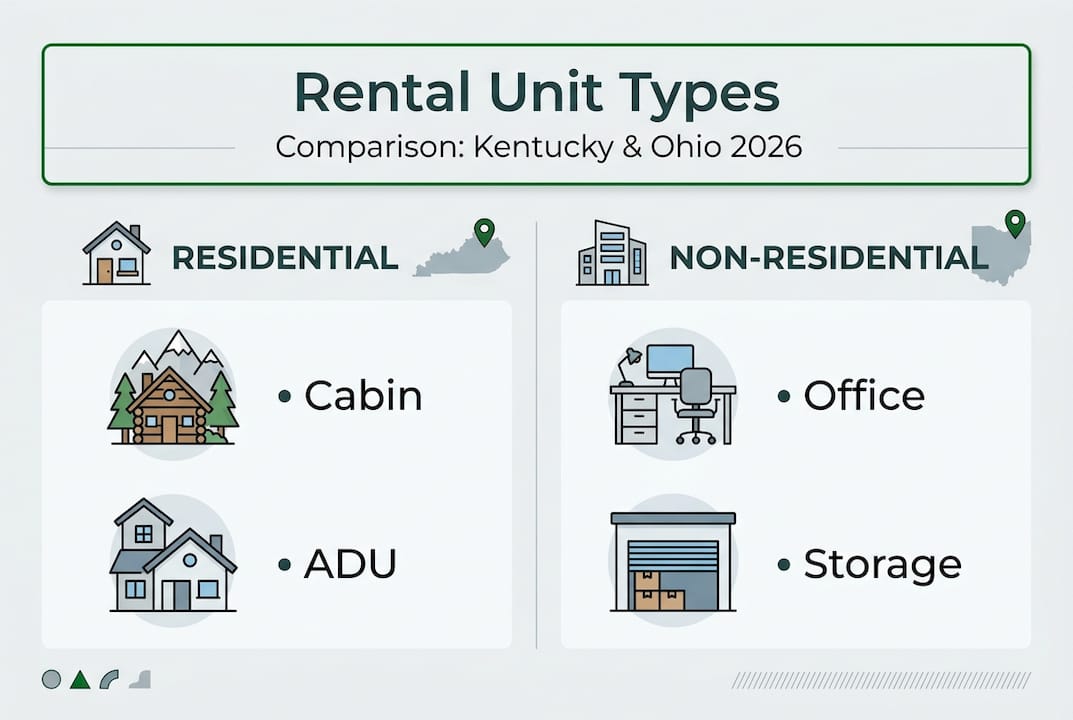
The key difference between these options is residential vs. non-residential use. Storage containers and portable offices are built for work and storage, not living. Cabins and tiny homes are designed with habitability in mind, meaning insulation, plumbing, and electrical systems. Choosing the wrong type for your intended use can create legal and comfort problems fast. Check out small building ideas for more inspiration on how people are using these structures creatively.
How customizable rental units work in Kentucky and Ohio
One of the biggest advantages of today's portable structures is how much you can personalize them before delivery. This isn't a "take it or leave it" market anymore. Providers let you choose size, layout, exterior color, door placement, window count, and interior features like shelving, insulation, or office partitions.
Here's how the typical process works from start to finish:
- Choose your structure type and size based on your intended use (storage, office, living, or mixed).
- Select your features such as split storage and office layout, loft space, or full cabin amenities.
- Confirm site readiness including level ground, access for delivery trucks, and any utility hookups needed.
- Schedule delivery with your provider. Customizable container rentals can be delivered directly to a residence or job site, often within days.
- Install and use with most units going in at ground level, no foundation required for non-residential types.
For homeowners, the most exciting use case is converting a portable cabin into an ADU. This gives you rental income potential or a private guest space without a full construction project. For business owners and contractors, a portable office setup on your job site can cut commute time and improve project coordination. Some teams even use construction collaboration mobile apps alongside their portable offices to reduce waste by up to 25%.
It's worth noting that portable offices and storage often lack residential amenities like plumbing and full kitchens, while cabins and ADUs are purpose-built for living. That distinction matters a lot when you're planning your setup.
| Feature | Storage container | Portable office | Cabin/ADU |
|---|---|---|---|
| Plumbing | No | Optional | Yes |
| Electrical | Optional | Yes | Yes |
| Insulation | Basic | Standard | Full |
| Permit needed | Sometimes | Sometimes | Usually |
| Relocatable | Yes | Yes | Sometimes |
Pro Tip: Always ask your provider about local delivery fees and site prep requirements before signing anything. A flat delivery quote can jump significantly if your driveway isn't accessible or your ground isn't level.
For customizable cabins specifically, the design choices you make upfront directly affect your resale value and rental income potential later.
Local laws and zoning: What you need to know before you rent
This is the section most guides skip, and it's the one that can cost you the most. Zoning laws in Kentucky and Ohio are not set at the state level for most portable structures. No statewide mandates for ADUs exist in either state, which means every county and city writes its own rules.
That creates a patchwork of regulations that can be confusing. Cuyahoga County in Ohio has been progressive about ADUs and accessory structures. Some rural Kentucky counties have almost no formal rules on the books, which sounds like freedom but can actually create problems when you try to sell or insure your property later.
Here are the key legal pitfalls to watch for:
- Electricity hookups: Some counties require a licensed electrician and permit even for a simple outlet in a storage container.
- Plumbing: Adding a toilet or sink to any structure typically triggers full habitability review.
- Foundation requirements: A few jurisdictions require permanent foundations for anything over a certain square footage.
- Habitability certificates: If you plan to rent out your cabin or ADU for income, you may need a certificate of occupancy.
- HOA restrictions: Even if the county allows it, your homeowners association may not.
"The biggest mistake homeowners make is assuming that because a structure is portable, it doesn't need a permit. Local zoning officials see it very differently, especially if someone is living in it."
Homeowners can rent out customizable ADUs as passive income, but must verify local zoning for habitability first. It's also worth knowing that almost half of homeowners delay renovation and building projects due to uncertainty about the process, and zoning confusion is a big part of that.
Pro Tip: Your first call should be to your county planning or building official, not a contractor. Ask specifically whether your intended structure requires a permit, what setback distances apply, and whether short-term rental use triggers any additional rules. This one call can save you thousands.
If you're thinking about financing your structure, understanding zoning first makes the portable building financing process much smoother.
Maximizing value with smart rental choices
Once you know what's legal on your property, the focus shifts to getting the best return on your investment. Whether you're renting a unit for personal use or planning to generate income from it, a few smart moves make a big difference.
Here's a quick checklist for evaluating any provider before you commit:
- Check reviews and reputation on Google and the Better Business Bureau.
- Verify insurance coverage for delivery, installation, and the unit itself.
- Ask about after-rental support including repairs, relocations, and buyout options.
- Confirm delivery timelines and what happens if your site isn't ready.
- Review the contract for hidden fees, early termination penalties, and damage policies.
On the investment side, the numbers are compelling. Tiny homes cost $80k–$150k to build, while cabin rentals bring in $250 or more per night in popular areas. A well-placed cabin on your rural Kentucky or Ohio property could pay for itself in two to three seasons of short-term rentals.
For long-term ADU use, the ROI timeline is longer but more stable. A rented ADU generating $800 to $1,200 per month can offset a significant portion of your mortgage or property costs. The key is choosing a structure that holds its value and can be repurposed if your needs change.
Rent-to-own programs are one of the smartest ways to reduce upfront costs. Instead of a large down payment, you make monthly payments that build toward ownership. Seasonal demand awareness also helps: pricing your cabin rental higher in fall foliage season or summer can dramatically improve your annual income.
Established providers bring real advantages in reliability, compliance knowledge, and after-sale support. Check out the prefab shed benefits that make factory-built structures a smarter long-term investment than DIY alternatives.
Why most people overlook flexible rental units (and what you should really consider)
Here's what most real estate guides and even local realtors won't say out loud: flexible rental units aren't a backup plan. They're a strategic asset that most Kentucky and Ohio property owners are leaving on the table.
The old thinking goes like this: portable structures are for people who can't afford a real building. That thinking is wrong, and it's expensive to hold onto. The smartest property owners we've seen aren't using cabins and container offices as temporary fixes. They're using them as adaptable infrastructure that changes purpose as their lives change.
A cabin that's a guest house today can become a rental unit next year and a home office the year after. A storage container that holds equipment now can be converted into a studio space later. The key insight is that you're not buying a fixed structure. You're buying optionality.
What savvy owners do differently is design or choose units with future repurposing in mind. They pick layouts that work for multiple uses, choose finishes that appeal to renters, and select structures that can be relocated if they move. Read more about this approach in our piece on affordable living and investment through customizable cabins.
The one overlooked tip: always ask yourself, "If my needs change in three years, can I rent this out, sell it, or move it?" If the answer is yes, you've made a smart choice.
Explore your rental unit options with EZ-Cabin
You now have a clear picture of what's available, what's legal, and what delivers real value in Kentucky and Ohio. The next step is finding the right structure for your specific situation.
EZ-Cabin offers a full range of customizable cabins, sheds, portable offices, and storage buildings with rent-to-own options and guaranteed financing approval. No credit check required, and only the first month's payment gets you started. Use our online tools to build your own structure in real time, adjusting layout, color, and features before you buy. Browse our full inventory at shop all buildings or explore financing options that make ownership accessible without the traditional dealership hassle. Our locations in London, KY and Somerset, KY are open if you want to see the buildings in person before deciding.
Frequently asked questions
Can I legally live in a portable storage container in Kentucky or Ohio?
You must check local city and county zoning codes first, since portable offices and storage are not designed for residential use without specific upgrades, permits, and habitability approvals.
What is the average cost to rent a cabin in Kentucky's Red River Gorge?
Short-term cabin rentals typically range from $250 to $500 per night depending on size and amenities, with some shipping container cabins earning perfect guest ratings of 10.0.
Are there rent-to-own options for portable cabins or sheds in KY and OH?
Yes, many providers including EZ-Cabin offer rent-to-own programs with no credit check required, making it easy to get started with just the first month's payment.
How fast can I get a portable office or storage container delivered?
Delivery can often be arranged within a few days, since storage containers and offices are widely available with ground-level installation and relocation options depending on provider inventory and your site readiness.
Recommended
- Customizable cabins for affordable living and investment
- Types of portable buildings: affordable KY & OH options
- Top benefits of prefab sheds for Kentucky and Ohio homeowners
- Livable sheds in Kentucky and Ohio: your complete guide
- Cost Rental Housing Guide 2025: Everything You Need to Know - Guestly Homes